Showing posts with label Pennsylvania. Show all posts

Wednesday, April 12, 2023

The Saddest Little Brownie in Pennsylvania


So a couple of years ago, I had exhausted most of my supply of unexplored broken chains as well as most of my interest in visiting and writing about them. My visits to surviving locations of Western Steer, Gino's, and K&W Cafeteria were left undocumented here due to that lack of interest (You can see pictures of them on my Instagram though.) After that final chain breaking trip through the Carolinas, I decided to go shopping for some new hobbies. 

After an attempt at buying, refurbishing, and selling used cars for fun and profit yielded little of either, I decided to follow whatever interested me even slightly to see if anything would stick. Earlier, my exploration of broken chains had led me to a newfound appreciation for cafeteria-style restaurants, which led me to the northeastern Ohio River Valley to check out two independent cafeterias, Mehlman’s in St. Clairsville, and Bricker’s in East Liverpool. Astute readers of Broken Chains and of maps of Eastern Ohio might recall I have family roots in the Steubenville area, which coincidentally is roughly halfway between the area’s two cafeterias. 

Dining at cafeterias in the part of Ohio where Appalachian economic devastation meets Rust Belt economic devastation naturally led me to bumming around Steubenville and the surrounding communities retracing the steps of my ancestors. Seeing a 3 speed bicycle for sale in an antique store in a converted prewar department store building in downtown Steubenville, plus an 11 mile paved bike trail running through nearby Scio, Ohio (Scio rhymes with Ohio.) led me to collecting, refurbishing and riding mostly 3 speed bicycles from the 1970s and 1980s. (You can hear more about them on my other Instagram.) Consequently, the majority of my hobby resources have been devoted to hanging out in what used to be Ohio’s steel country and hoarding, fixing, breaking, re-fixing, and riding cast-off obsolete bicycles.  

I was on a side trip to Butler, PA to ride my trusty 1978 Schwinn Speedster on a nearby rail trail, and I had learned of a broken chain in the Pittsburgh area. Kings Family restaurants, a chain initially and confusingly named Kings Country Shops when it’s first location opened in 1967 would later change its name to Kings Family Restaurants to better indicate the type of business a visitor to a Kings location might expect. The chain peaked with 34 locations in Western Pennsylvania and Eastern Ohio around 2006, but the 2008 recession and mismanagement by subsequent owners of the chain were not kind to those locations, as only four Kings remain open today. 

I made two efforts to visit Kings locations on that trip. The first of which, in Kittanning, PA was unsuccessful, as local student athletes were posted outside the door to the restaurant soliciting donations from passersby in exchange for holding the door. I had a raging case of social anxiety at the time, and indeed, it was raging during essentially the entire time I was regularly updating this blog. As a result, I wasn’t up for dealing with people beyond ordering lunch, so I gave up on eating Kings in Pennsylvania and  headed toward Ohio where I’d be spending the night near the state’s only surviving King’s location in Wintersville, just outside my beloved Steubenville. It was at the Wintersville Kings where I visited the restroom upon my arrival to find a man in a line cook’s uniform unclogging a terlet and failing to wash his hands once the task was completed. I took that as a sign that I probably shouldn’t eat at the Wintersville Kings, so no Kings meals were had on that trip. 

A year went by. I was back in Eastern Ohio for what had become a quarterly visit for hiking, mall walking, cycling, and eating too much Steubenville-style pizza, and I was not terribly surprised to learn that the Wintersville, Ohio Kings had gone out of business. I also found the road to a hiking trail I planned to visit closed, leaving me with some free time and a strong appetite thanks to a 23 mile ride on an antiquated folding bike that same day. I had also taken my anti-anxiety medication that morning, and was sufficiently prepared to casually converse with anyone who might cross my path. A quick look at Google Maps told me the nearest operating King’s was still open less than an hour away just outside Pittsburgh in Canonsburg, PA, and it seemed like as good a time as any to see if I could still have fun experiencing a broken chain. 

I've previously introduced you to the Empress of Alexandria. Now meet the Kings of Canonsburg. 

I hopped in the car and drove from the eastern edge of Ohio, across the narrowest part of West Virginia’s northern panhandle, and into Pennsylvania where I found the Canonsburg Kings situated at a nondescript intersection. I walked from my car to the entrance, noting a leaky looking 1980s Rax/Wendy’s style solarium on one side of the building and loose siding hanging off the exterior wall near the entrance. The modern red and yellow sign out front failed to manage the heavy lifting of making the rest of the place seem inviting. 

A dated, but clean interior

Once inside I was greeted with a bakery case full of pies and King’s signature “Frownie Brownies,” literally brownies with frowny faces of icing piped on as a rebuttal to Pittsburgh-area competitor, Eat ‘n Park’s “Smiley Cookies.” A manager could be heard to one side of me profusely apologizing to a table of less than pleased diners, presumably for sub par food and/or service. My presence attracted the attention of a teenage host who showed me to a booth far from the solarium where seemingly no one was seated. Before I had a chance to look at my menu, the same manager had found his way to yet another table of dissatisfied customers and offered them the same carefully worded apology. It was around then that a server who exuded an overwhelmed aura came to take my drink order. 

Frownie Brownies

I asked her for a diet brown soda and listened to the man a couple tables away who had just received an apology from the manager muse to his indifferent wife, mortified teenage son, and oblivious father in law in the booth with him that he had never heard of Brendan Fraser until this year. His wife quickly changed the subject about the poor level of service they had received, and when the same overwhelmed server came by to drop off my drink and their check, they complained to her and again asked to speak to the manager who reappeared and again apologized, and the server could be heard to remark that it was only her second day on the job, and there were only two servers working that day. The manager seemingly comped their check, as the group left without paying. 
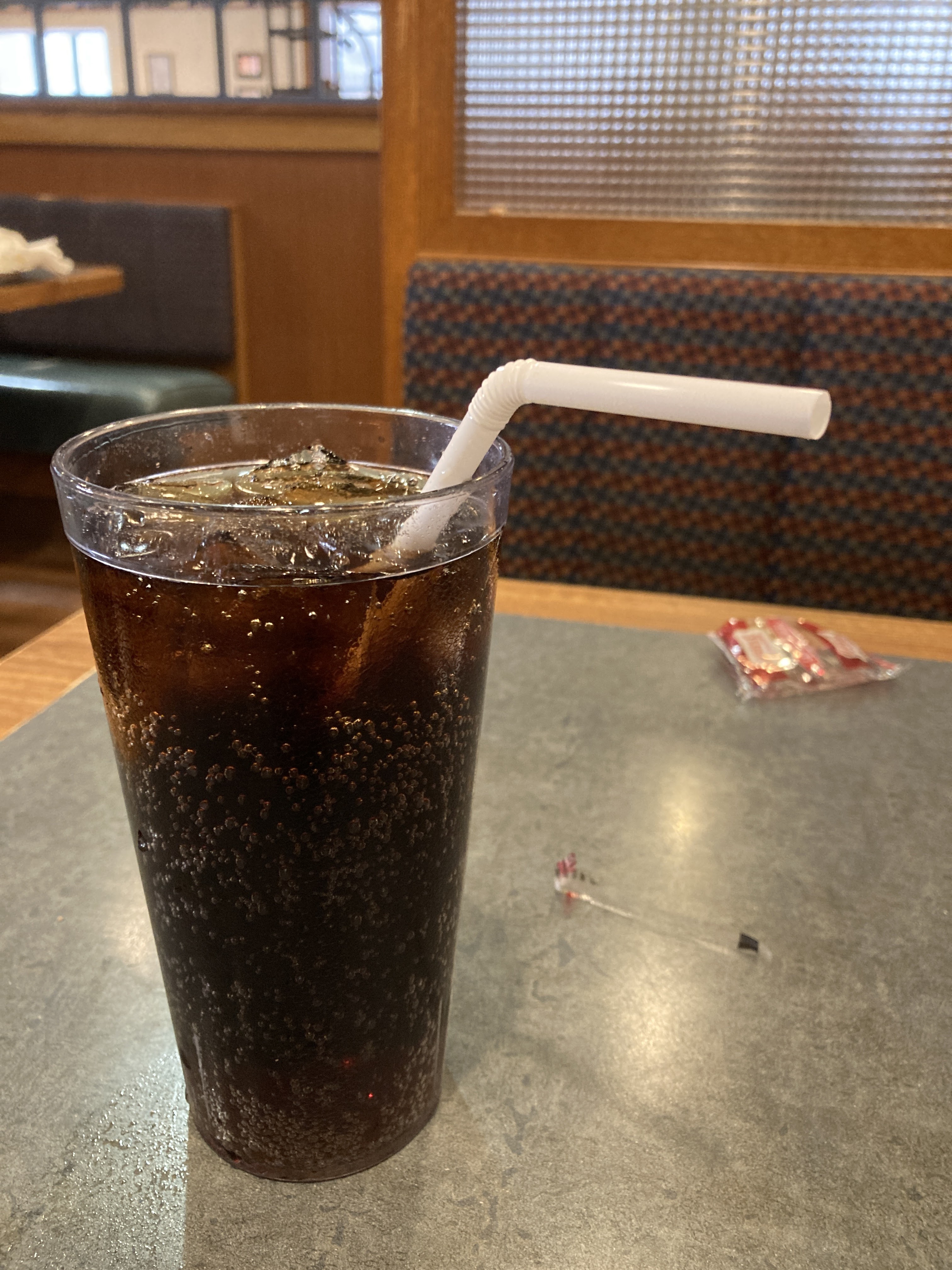
Environmental concerns aside, I really enjoy a good bendy straw. 

You know what else I’ve gotten into lately? The cartoon, Bluey. I am a 37 year old man with no children of my own, no niblings, literally no one under the age of 30 with whom I interact regularly, but I’ve found an appreciation for the unique animation style, witty writing, and wholesome vibe of an Australian show for preschoolers about a family of cartoon dogs. There’s a recurring gag on Bluey where the titular character and her sister Bingo, both preschool-aged dogs, don silly glasses and wrap themselves with blankets and pretend to be grannies named Janet and Rita. When in character as The Grannies, Bluey and Bingo do stereotypical granny things like driving their toy car recklessly, needlessly delaying others on public transportation, and slipping and falling on cans of beans. I only bring all of this up, because as the disgruntled family whose patriarch was unaware of films like Encino Man, George of the Jungle, and Blast from the Past, were leaving, the real life Janet and Rita walked in. They were live action, human women, of course, but they had big “I slipped on mah beans!” energy. 
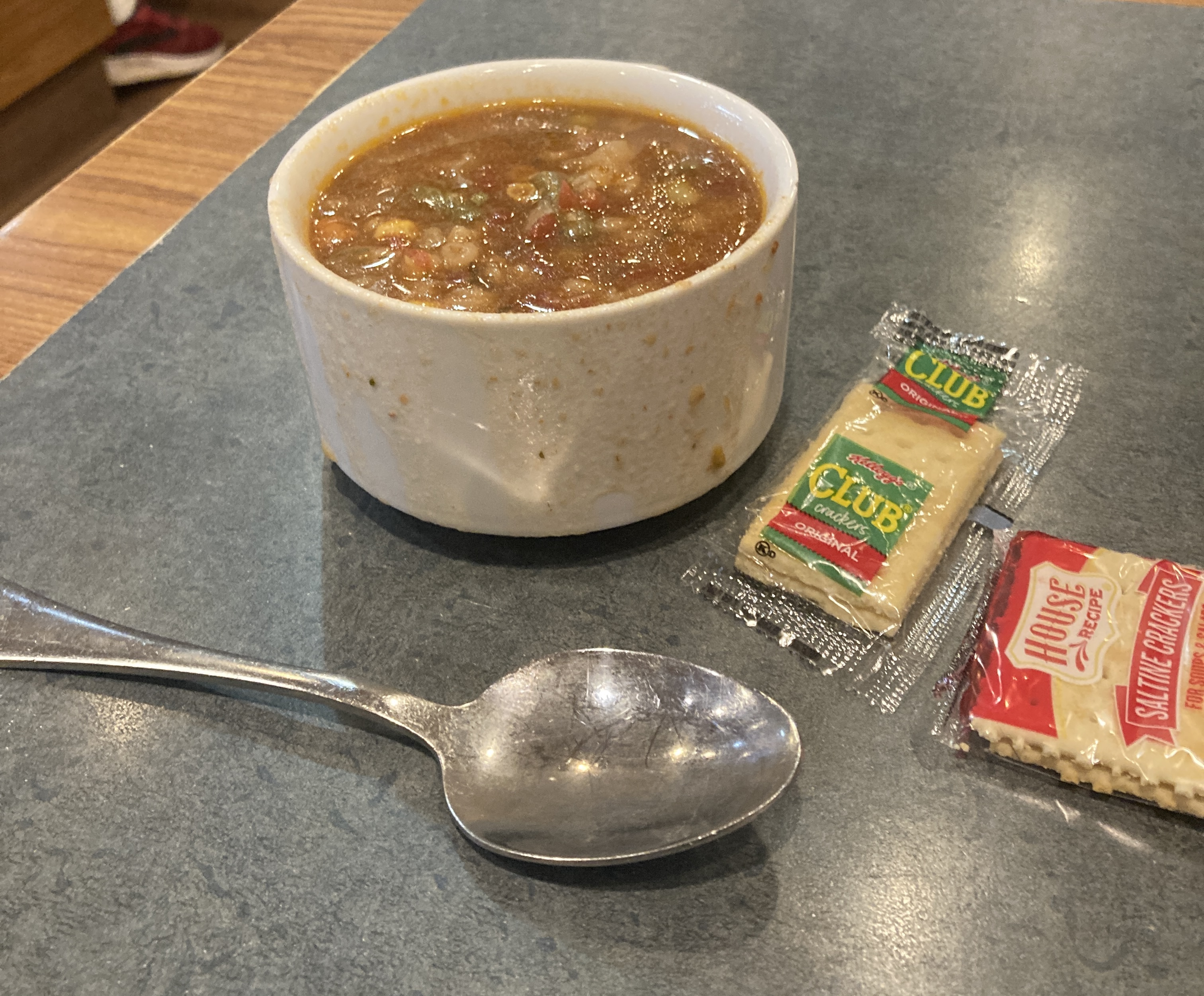
A very good vegetable soup with questionable presentation. 

The same host seated them at a booth directly opposite me, as I was ordering my preferred dinner, beef vegetable soup, turkey, stuffing, mashed potatoes, and coleslaw. The same overwhelmed server took their drink orders, visibly agitated after taking my dinner order. After she sulked into the kitchen, the more talkative of the two grannies asked me if they used real or deli turkey for the turkey plate. It was my first time at King’s, so of course I had no idea, and that’s what I told her. Overwhelmed waitress returned with my cup of soup, setting the soup spoon down directly on the tabletop which was of dubious cleanliness.

I decided it wasn’t worth complaining about given my server’s seemingly fragile emotional state, so I elected to test my immune system by eating the soup with the questionable spoon. I’m writing this a few days later, and I’m happy to report I’ve seemingly suffered no adverse effects, and the vegetable soup, clearly made from scratch, was very good. 

Turkey and such. The stuffing is under there somewhere. 

I was blowing on my second spoonful of soup when a presumably more experienced and noticeably less harried waitress came with my turkey plate. Despite the apparent lack of staffing, my food arrived quickly. I sensed the talkative granny at the next table eyeing my plate and I picked it up so that she could thoroughly inspect the turkey. She declared it looked like lunchmeat, and she wasn’t wrong. It was one broad, thin slice of turkey breast that covered a little mound of stuffing like a blanket. Tasting it made it clear it hadn’t been carved off of a whole turkey breast in the kitchen, but it had been cooked and sliced elsewhere, likely days or weeks earlier. It was at least a real slice of turkey breast however, not a uniform shaped slice of compressed turkey trimmings like you’d find in a package of cheap sandwich meat or an old fashioned TV dinner. The flavorful gravy and stuffing were definitely the stars of the show, as they so often are with turkey dinners. Unsurprisingly, the coleslaw was unremarkable, as coleslaw often is.

The visibly distraught waitress returned around this time to take the grannies’ order, and in true wholesome Australian cartoon dog fashion, they paused to ask her what was bothering her and to offer a pep talk. She again said it was only her second day of work and they were understaffed, that her boyfriend had broken up with her before the start of her shift, and that multiple tables had not been tipping her and/or been complaining to the manager. I felt a little guilty ordering dessert when she clearly just wanted to give me my bill, though the grannies’ “Don’t let the general public get you down.” speech did seem to perk her up a bit. 

She returned, some time later, with my order, apple pie garnished with King’s signature pink cinnamon ice cream. The latter was delicious. It’s hard to find cinnamon ice cream, let alone good cinnamon ice cream that has just a hint of background heat, like a red hot candy but isn’t overly sweet. That’s exactly what King’s ice cream was. The pie, on the other hand, was stone cold. It had clearly been taken out of a cooler, and my poor server hadn’t thought to warm it up. She also completely forgot the Frownie Brownie wrapped up to go that I had asked for twice. 
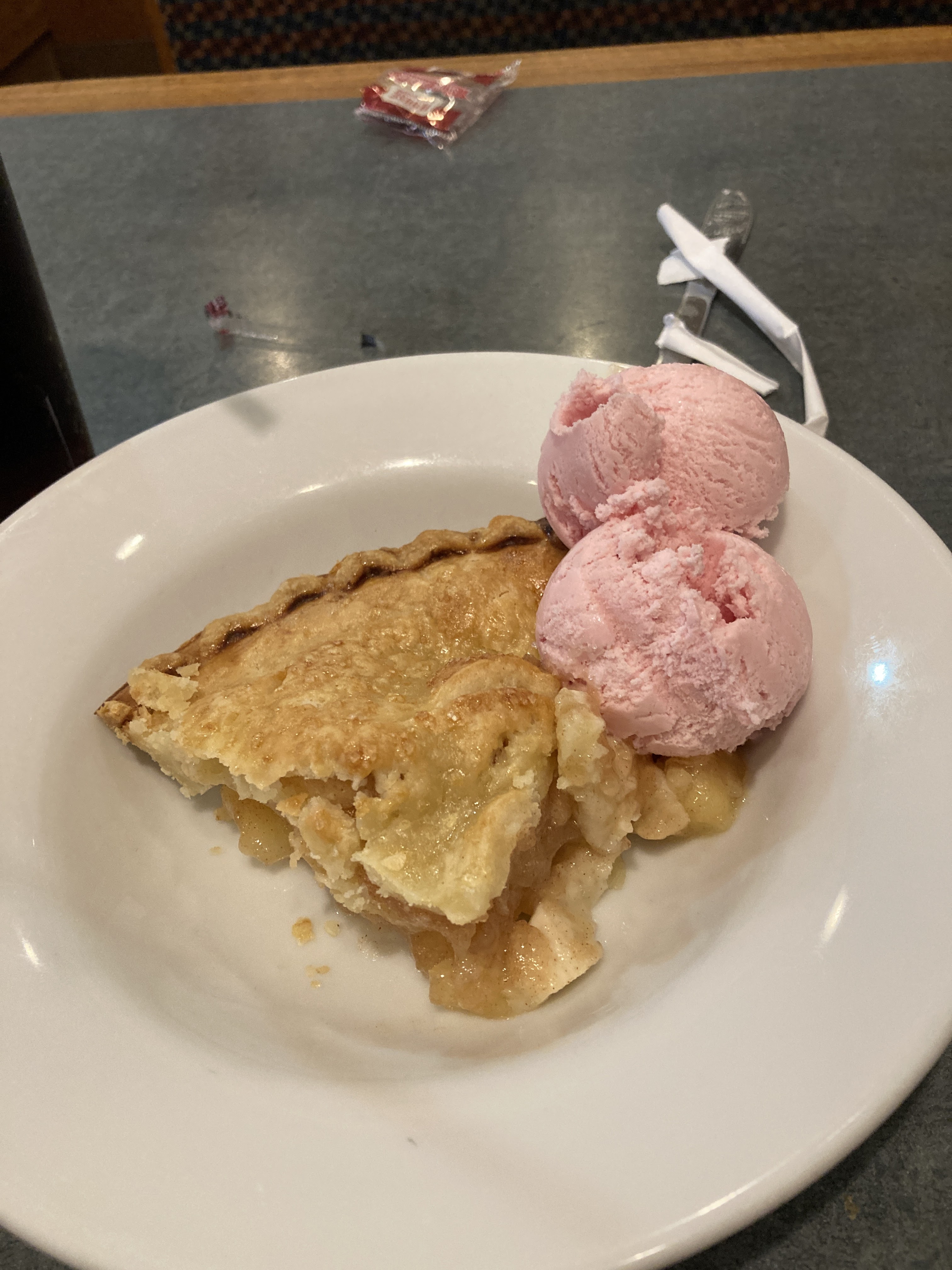
I would make a Smokey and the Bandit style Detroit-Pittsburgh run with a cooler full of dry ice if Kings sold this ice cream in half gallon containers. It's that good. 

She was very clearly having a pretty terrible day, and while the old unmedicated me might have bemoaned her lack of professionalism, the new, medicated Zap Actionsdower can offer her my empathy and/or sympathy, (I always forget which is which. They’re the Bill Paxton/Bill Pullman of emotions.) 

I’m sorry to say the hit or miss food, and service that I can charitably call memorable did not renew my interest in chain breaking, but as I saw tray after tray of frowny brownies at the front counter as I was settling my bill and leaving a pity tip that I could not think of a better representation of the remnant of King’s Family Restaurant. The dimly lit, dated interior, the so-so food, and the clearly unhappy staff were all perfectly represented by that frowning brownie conceived to mock a competitor, which seems to be faring noticeably better than King’s, as I left with a similar expression on my face, feeling no desire to return or to visit other locations and with my already diminished desire toward chain braking diminished just a little bit more. Maybe I’ll track down another broken chain in a year or two, but don’t expect new blog posts after this one anytime soon, which isn’t to say I’m done writing. I have a couple ideas for non-Broken Chains content on the back burner, but for now, I mostly just want to hang out in Steubenville, ride bikes, and watch Bluey. 


Thursday, February 20, 2020

...I Wrote About the Donuts!

This is the second part in my two-part series on broken donut shop chains. Before you read on, I suggest you go read the first one if you haven’t already.


A good many restaurant brands founded in the US have departed that market entirely. For instance, the last operating US Chi-Chi’s closed in 2011, but there are still Chi-Chi’s locations open for business in Belgium, The Netherlands, and Luxembourg. The last Kenny Rogers Roasters in the US closed around the same time as the last Chi-Chi’s, but there are locations still open all over Southeast Asia, where I can only imagine The Gambler doesn’t have much of a fan following. It’s tough to visit a Kenny Rogers Roasters or Chi-Chi’s without boarding an international flight, and a trip to Luxembourg or Indonesia for a broken chain meal or two is something I’ve not yet mentally prepared myself for. However, I did recently experience a chain that is all but forgotten in the US, but is huge in Asia, and the most exotic lands I visited in the process were Illinois and Pennsylvania.

Even with its recent shift in focus and name away from donuts, Dunkin is the most successful survivor of the decline of the American donut shop, but Dunkin had a rebellious child named Mister Donut. Mister Donut was founded by Harry Winokur, the business partner and brother in law, William Rosenburg, founder of Dunkin Donuts. Winokur exited the partnership in 1956, and borrowing his brother in law’s idea, opened the first Mister Donut, soon franchising and growing the brand rapidly. Mister Donut was acquired by International Multifoods Corporation in 1970, and the first Mister Donut in Japan opened a year later. The Mister Donut chain peaked at around 550 North American locations in the International Multifoods years, but the beginning of the end came in 1989 when the British conglomerate Allied-Lyons acquired both Dunkin Donuts and Mister Donut. The new corporate overlords forced Dunkin Donuts to metaphorically eat its own young, as US Mister Donut operations were merged into the Dunkin Donut chain, and most surviving US Mister Donut locations were converted to the Dunkin Donuts brand. Mister Donut would continue in the East Asian market where it thrives today with locations in Japan, The Philippines, Thailand, Taiwan, and Indonesia, but only a single Mister Donut location remains open today on the North American continent.

The Godfrey, Illinois Mister Donut is one of a good many franchised locations that was either unwilling to convert to a Dunkin Donuts location or unable due to proximity to an existing Dunkin Donuts. These locations operated more or less independently and all but one would eventually change their names or simply close. I had a chance to stop in for breakfast on a recent trip in order to save myself the cost of a trip across the Pacific to see what Mister Donut was all about. 


I had spent the night previous in Springfield following dinner at the local Hen House restaurant, and left early the following morning, as I had a long run to the El Dorado, Arkansas Minute Man. the Godfrey Mister Donut was on the way. I arrived there before sunup and was greeted by the faded orange glow of a 1970s era Mister Donut sign complete with the Multifoods logo. The donut shop occupied the end slot of a small strip mall, and was brightly lit, serving as a beacon for passersby early on what was a cold December morning. I found my way across the parking lot and in the front door where the bright lighting continued along with brighter decor. Swaths of brilliant orange and harvest gold assaulted my eyes accustomed to the dark following an antithetical 90 minute early morning drive in the dark. Nearly every element of the decor of the dining area seemed to be straight from 1977, and a gaggle of regulars, men in their seventies rattling the pages of unfurled newspapers and harumphing as they offered their opinions on matters mighty and minute to anyone within earshot appeared as if they’d been coming there every morning since the place opened. As with the Mentor, Ohio Spudunt shop, there wasn’t much of anything new here in terms of decor, donuts, or customers, though multiple tabletop signs were advertising breakfast sandwiches that had been recently added to the menu. I didn’t bother with a breakfast sandwich. I was there to feed on the obsolete, not newly-conceived piles of bread, greasy pork and round, pale yellow egg patties whose constituent ingredients may or may not have come out of a chicken at some point. I ordered three donuts whose composition I wagered hadn’t changed much since “Disco Duck” was topping the charts, and a bottle of Diet Dr. Pepper. (I never developed a taste for coffee.) I then selected a booth near the door to assess my order and surroundings. 

Just look at this visual spectacle! You don't last long in the donut business if your food presentation game isn't on point. 
The first donut out of the bag was a honey dip, and while, like many donuts with the word “honey” in their name, it didn’t have much in the way of honey flavor, it was a perfectly serviceable glazed donut. A cherry cake donut came next, cracked around the edges and shimmering with a thick, crunchy glaze. Its flavor was sweet enough to take down an army of Wilford Brimleys, but the overwhelming sweetness carried with it only a hint of maraschino cherry fighting its way through the deluge of sucrose. Donut the third was the one I had looked forward to most, a cream filled chocolate long john, which despite the lack of maple icing, I hoped would come close to my beloved childhood donut from the Steubenville Big Bear. While the rich flavor dark chocolate glaze was a welcome surprise, the long john fell well short of the vague childhood memory I’ve been building up in my mind for the past 30 years. It was a little light on cream filling for my taste, with a wide, bready mass in the middle between two small cream pockets on the ends. 

"Honey" dip

Cherry

l o n g b o i

Despite the mediocrity of the donuts, I couldn’t help but think that I was in a special place, a place unaltered by modern food trends and marketing. Thanks to my habit of tracking down surviving locations of diminished and near defunct restaurant chains, I encounter these stuck in time places a couple of times per month on average, but two years in, I haven’t tired of finding these modern shrines to fast food history. On the contrary, each rock I uncover to find a place like Mister Donut underneath makes me want to turn over more rocks, and that’s exactly what I did. 

I came here to eat donuts and gawk at dated decor, and I'm all out of donuts. 

I left Mister Donut feeling like I hadn’t quite had the entire experience, because just as Mister Donut was the troubled, rebellious child of Dunkin Donuts, Mister Donuts had wayward offspring of its own in the form of Donut Connection, a chain formed by owners of franchised Mister Donut locations that were unwilling or unable to convert to the Dunkin Donuts brand in the early nineties. Following my recent Donut tour of the Cleveland suburbs, I traveled east into Pennsylvania to experience, Donut Connection, the other half of the Mister Donut story. 

Dunkin' Donuts begat Mister Donut, and Mister Donut begat Donut Connection, so it is written in the Book of Fermentations.

I’m unsure if Donut Connection itself is a broken chain, but I’m inclined to say it is based simply on the fact that it splintered from another larger chain the way Halo Burger and the various Big Boy chains did. I have no idea how many were open at the peak of the brand, or how many are open today, because half of the locations shown on the Donut Connection website show up as permanently closed when Googled. In general, the largest concentration of Donut Connections seems to be in the New York City area, with a few more strewn around Pennsylvania. There are a handful of surviving outposts as well, as far west as Minnesota and as far south as Florida. 

I found my way to the Butler, Pennsylvania Donut Connection on a Sunday morning. I had stayed nearby in Wexford, Pennsylvania the night before, and while I made the drive shorter and later in the day, it was no less grueling than the drive from Springfield to Godfrey, Illinois I’d made a few weeks before, thanks to the route of icy roads through the mountainous terrain north of Pittsburgh. The narrow roads with endless undulations and inclines and the smell of steel mill pollution in the air served to remind me of those childhood visits to my grandparents in Steubenville, which actually wasn’t terribly far away. I took it as a sign that I was in the right part of the country to have a shot at recapturing my beloved childhood donut memory. 

Look at that big green roof! There's gotta be a zigzag hiding under there, and I want to see it!
I arrived in Butler, in a part of town that looked like so many places in Western Pennsylvania, Eastern Ohio, and that weird skinny part of West Virginia that’s wedged between the two. Tucked in the streets lined with old homes built on impossibly steep hills and alternatingly thriving and empty storefronts was Donut Connection, sitting on a small lot carved out of the hillside, which extended sharply up behind it. The building sported a curious gabled roof that extended implausibly high above what would be the ceiling of the dining room. I surmised the building may have once sported the signature Mister Donut zigzag roof before the Donut Connection days as I walked through the door. 

This was a popular place on a Sunday morning. I got there before 9:00 and they were already running low. 

The selection of donuts sat on shelves behind the order counter below a decades-old menu board with faded pictures of donuts and handwritten strips of paper showing menu items and prices. I procured three donuts, a cup of milk, and another of coffee which I had no intention of drinking, so I’d end up with a Donut Connection cup for my own collection and another for Carl Poncherello’s. I placed my various donuts and beverages on a small pink tray from the pile on the counter and proceeded to a corner booth where I surveyed my surroundings. Donut Connection’s turquoise and pink color palette dominated the decor in place of Mister Donut’s orange and gold. The decor had a slightly more modern aesthetic, smacking of the early nineties rather than the late seventies, although seemingly the same group of opinionated, retired men I’d encountered in Illinois were seated at the counter of this donut shop in Pennsylvania, though they’d shed their plain Midwestern accents for Pittsburgh ones peppered with odd words like “yinz” and “deeshwarsher.”

The view from my table. Turquoise everywhere. 

The first donut on deck was a maple glazed, which to my delight was as mapley as my beloved childhood donut, though of course, the hole in the middle meant it lacked any of the cream filling crucial to recreating my childhood memory. It was succeeded by a blueberry cake donut that actually tasted like blueberries, which was refreshing given the promises that had recently been made to me and broken by its allegedly cherry flavored cousin at Mister Donut. I giggled to myself as I had the thought that Donut Connection was the William Wonka of donut shops, and if snozberries actually existed, a sonzberry donut from Donut Connection would indeed taste like snozberries. 

Bag o' donuts

A decent maple, but it needs filling. 

A blueberry donut fit for Violet Beauregard
Nostalgic, magical mystery donut.
My next donut found me in a world of pure nostalgia rather than one of pure imagination. A cream filled, chocolate iced, yeast donut was my final selection, and while its icing was in no way maple-related, the composition of its vanilla buttercream filling, and the ratio of the filing to its greasy, glutenous surroundings was perfect. I was instantly transported to the shag carpeted rumpus room of my grandparents’ Stuebenville home, watching a fuzzy broadcast Garfield and Friends on the old RCA cabinet TV while I munched a maple long john from Big Bear. At last, I’d recaptured my childhood donut! I had to fight back the urge to hop up from my booth and dance as if my grandson had just won a tour of a chocolate factory.

♬I never thought that what I ate, 
In a donut shop in the Keystone State,
Could begin to even replicate, 
What I’d eaten in ‘88!

‘Cause I’ve got my childhood donut!
I’ve got a childlike twinkle in my eye!

I never thought that I could drive,
Over the hills of Pennsylvain’, 
But now to my surprise I find, 
An end to my donut campaign!

‘Cause I’ve got my childhood donut!
I’ve got the cream filled treat to make my day!♬

The next few hours were a blur of donut-fueled euphoria, and I honestly don’t remember much that transpired after I’d finished that donut. I was on my way home on I-75 south of Toledo when I suddenly regained my senses. It occurred to me then and there that I didn’t remember what that magical donut was called. Sure enough, in my pictures, the label below the tray of those donuts wasn't visible. Furthermore, the locations map on the Donut Connection website doesn’t show a Donut Connection in Butler, Pennsylvania, so all I have to prove that the whole thing wasn’t a dream were the pictures I took and a couple of Donut Connection cups rolling around in the back of my car. Still, I can’t help but be suspicious that should I return to that same spot, I might only find a vacant Pennsylvania hillside with no sign of a Donut Connection ever being there at all. In a way, it's fitting that the donut experience I’ve chased off and on since one of my earliest childhood memories remains fleeting. That makes it all the more special when I do find a donut that lives up to the one I had all those years ago. At the very least, I can take solace in the fact that this experience taught me that the flavor of the donut’s icing doesn’t matter and it’s what on the inside that counts. 


Sunday, September 15, 2019

Individual Seeking Authentic Lactose Yearns Steadfastly


In my various silly adventures to surviving locations of broken chains, I try my best to find the essence, or at least what remains of the essence of the brand represented by each location. My curiosity and desire to document forgotten history motivate me to seek out the food and experiences that are represented by prickly, subjective, adjectives like “authentic” and “quintessential.” My success in finding the quintessentially authentic in the places I visit is varied. When circumstances allow, I try to visit multiple extant locations of the same chain to gain a well-rounded appreciation for the current state of a brand. However, in many instances, the lack of multiple surviving locations, and indeed my own limited time and resources prevents me from gaining the increased frame of reference that comes with stops at several outlets of the same brand.

I had been meaning to visit a couple places in Western Pennsylvania for months when I was afforded a narrow window of time to visit Pittsburgh on my way home from Johnstown, Pennsylvania where I ate at the last Pappy’s Family Pub. I had just enough time to stop just north of the city in West View at Isaly’s, one of around five survivors of a chain that once had over 300 units. Isaly’s, whose name rhymes with “fries, please” began with William Isaly whose chain of dairies spawned a chain of dairy stores which featured small restaurants. A loose corporate structure allowed the chain to expand rapidly, and by the early 1960s, Isaly’s locations were spread from Pennsylvania to Iowa. Isaly’s was known for its “chipped-chopped” ham sandwiches, "skyscraper" ice cream cones, which featured a tall, conical scoop of ice cream perched atop an ice cream cone, mirroring its shape. Advertising often used the mnemonic “I Shall Always Love You, Sweetie” to help customers remember the correct spelling of Isaly’s name. Most notably, however, Isaly’s developed an ice cream novelty that consisted of a square of vanilla ice cream covered in chocolate and wrapped in foil, the Klondike Bar, which has a fascinating history all of its own. Eventually, Isaly’s fell victim to the same loose corporate structure that had allowed it to grow so quickly. A lack of consistency and corporate oversight, coupled with widespread changes in the dairy industry caused the chain to shrink rapidly in the 1970s. The city of Pittsburgh had long embraced the Isaly’s brand to a greater extent than other markets, and the Pittsburgh area today is where three of the five remaining Isaly’s locations remain open. All remaining locations using the Isaly’s name seem to operate largely independently. While there wasn’t an abundance of consistency between Isaly’s locations in their heyday, there seems to be even less today.

Isaly's is among the most photogenic businesses I've visited for Broken Chains. 

My schedule was tight, and I could only visit a single Isaly’s location. I pored over Google Maps photos of each Pittsburgh-area Isaly’s, eventually deciding to visit the West View location based on the photos I found of its nicely-preserved interior. Surely, I could get a authentically quintessential Isaly’s experience in West View. I found my way into town on a Saturday morning. Isaly’s is situated on a quiet street lined with small storefronts on the ground floors of two and three style buildings in an old, but still vibrant neighborhood. I parked on the street at the end of the block and walked half a block uphill to Isaly’s. Following an ownership change a few years ago, the official name of this location was changed to the “I Shall Always Love You, Sweetie” mnemonic, but the sign of the building remained unchanged except for a period after each letter to reflect that it was an abbreviation for the full name. What awaited me past the minimally modified sign made good on Google’s promise of a time warp interior. 

Inside, it's a museum of old Isaly's decor and signage.

Original light fixtures hung from an ornate tin ceiling. Vintage Isaly’s signs and advertisements lined the walls. The tile floor was nearly identical to the tile floor in the bathroom I had when I lived in an apartment building that was built in 1937. While there were reminders of modernity here and there, it was clear that the owners of the West View Isaly’s had a deep appreciation for the brand’s history and wanted to share that appreciation with clientele. I could at least rest assured that I had found the most  authessentially quinthentic Isaly's dining room. I eschewed the modern tables and chairs and settled into an old built-in booth with an ancient Formica tabletop.

I really want to know what I could have won at Isaly's 60 years ago. Or are they raffling off that vent hood? 


A server appeared with a printed menu whose cover contained more allusions to the legacy of the Isaly’s brand. I decided then and there to order breakfast, and follow it up with ice cream to make the most out of my only planned Isaly's meal. Isaly’s specialty chipped ham was available as a breakfast side, so when I my server returned I ordered the pecan pancakes I always seem to end up ordering when I can, along with a side order of ham. 

I too am ashamed of the things I've done for a Klondike bar. 

Why yes, I do have a fixation with tile floors. Thank you for noticing. 

While waiting for my order to arrive, I played a word game with myself, trying to come up with other backronyms that could be represented by the constituent letters of Isaly’s. My fondness for raw denim nearly immediately led me to “Indigo Should Always Line Your Shins.” My cursory knowledge of former Cincinnati Bengals fullback Elbert “Ickey” Woods’ signature celebratory end zone dance resulted in “Ickey Shuffle Always Leaves You Sore.” Finally, I broke out the thesaurus app on my phone to string together a mnemonic to help me remember either Kentucky’s first governor, or the state where country musician Dwight Yoakam was born, but not both facts. “Isaac Shelby Antecedently Led Yoakam’s State.” I was pondering a fourth acrostic that involved iodine salve when my food showed up.

Pretty great pancakes. 

The pancakes came with individual cups of imitation maple syrup like you'd find at a continental breakfast at a mid-priced hotel, but the cakes themselves were fresh off the griddle and delicious. The ham was exactly what I expected, deli ham warmed up on the grill, but it was good quality ham that provided a salty counterpart to the sweet pancakes. I'd get it again, even if it wasn't the arithmetically quasquicentennial breakfast side of Isaly's. I was so busy pondering the flavors and significance of the briny, porky, historic, breakfast protein, that I didn't notice my server drop off my bill. Since my arrival the place had started to fill up, and the staff were busy tending to other customers. Not wanting to inconvenience the busy staff or stand out as a tourist in the busy neighborhood restaurant, I decided, in the moment to skip the ice cream and continue on my journey home. It's a decision I regret. 

I like my Waffle House hashbrowns scattered, smothered, and covered and my Isaly's ham chipped, chopped, and grilled. 

Since my visit to Isaly's, I haven't had an opportunity to go back to try the ice cream at that or any other locations. I haven't even had a chance to visit one of the handful of Pittsburgh-area grocery stores that I learned too late carry Isaly's branded ice cream. Indeed, all my recent travels and upcoming posts have led me to travel west from my Metro Detroit home, not east. I've had to settle for the occasional Klondike bar from my local Meijer for my Isaly's ice cream experience, but Unilever has been the sole producer of Klondikes since 1993, and my Eastern Ohio born and raised mother tells me that the modern Klondikes don't taste anything like Isaly's Klondikes did in the sixties. My Isaly's experience, while uniquely retro and historically hammy, falls short of feeling quintessential or authentic without ice cream, but that's something I'll have to live with for at least a few months until I get back to Pittsburgh. 


One of the many reasons I can't get back to Pittsburgh for Isaly's ice cream any sooner is that I'll be at Raxgiving at the Harlan, Kentucky Rax in November. If you're a fan of Broken Chains, the blog, or broken chains, the surviving locations of mostly defunct restaurant and retail chains, consider joining me for a meal and informal conversation. 


Monday, August 19, 2019

Pizza for One

♬Cheese by the ton on a Margherita
Just pizza for one, 
And one for pizza
Just me for pie
And pie for me alone. 


Strangers a-souring 
At my wanton devouring,
Extreme gurgitation 
On my Keystone vacation 
Pictures of my Pappy, dear,
On my iPhone, crappy, dear


Yum! Brands announced last week that they’d be closing 500 sit-down Pizza Hut locations and increasing the focus on pizza delivery. It’s a move that is hard to watch for anyone who grew up eating pizza under a distinctively-shaped red roof and behind trapezoidal windows, but it's hardly a surprising move. From the rise of the American sit-down pizza parlor started by Shakey’s in the fifties to the present-day, dine-in pizza experiences have slowly become a rarity. Over the years, people discovered that pizza traveled well in a flat cardboard box, and was the perfect food for a delivery business model. Reducing the overhead and complexity of operating a sit-down restaurant in favor of a carry out/delivery setup made business sense for both parent companies and franchisees, and pizza became the default delivery food in North America. People, in general, seem to prefer to eat pizza at home, and with the rise of delivery services, the idea of enjoying a meal out at an inexpensive restaurant is becoming increasingly antiquated. Is it any wonder then, in a time when Postmates and DoorDash will deliver food to your door from nearly any restaurant, that the largest pizza chain in the world, who has been slowly, but steadily, closing sit-down locations for years to the point that entire blogs are devoted to the phenomenon, is set to close 500 of its remaining dine-in locations en masse? 

My local Hut's days are probably numbered.

With market trends being what they are, it’s tough to make a long-term business case for any sit-down pizza chain, but for anyone who grew up having meals out at Pizza Hut, Shakey's, Godfather's, and innumerable other regional chains and mom and pops, it’s a little sad. However, as with most chain restaurants, there are always holdouts that cling to a bygone era and anachronistic business model in the face of a changing marketplace.

“It’s very difficult to keep the line between the past and the present.” 

That's the standout line of the younger Edith Bouvier Beale in the 1975 documentary, Grey Gardens. The film showed the everyday lives and interactions of an eccentric, reclusive, mother and adult daughter both named Edith Bouvier Beale, living in a derelict mansion in the Hamptons. They had been wealthy socialites decades before, but their failure to adapt to a changing world and their own changing fortunes left them living in squalor and obscurity, clinging to their memories of happier and more prosperous times. I saw the film for the first time recently, around the same time I was studying Pappy’s Family Pub, a suspiciously Shakey’s-like chain of pizza joints that operated In Pennsylvania, Maryland, and perhaps other nearby states in the seventies, and perhaps other nearby decades.  

Ignore the modern vehicles, and this picture would look like it could easily be from the late '70s

Like countless other pizza chains before it, Pappy’s locations gradually closed their doors as Domino's and Little Caesar’s made it increasingly clear that delivery and carryout were the future of the pizza business, but somehow, a single Pappy’s location remains open to this day, standing STAUNCH in the face of a changing pizza business. Based on a tip from a reader (Thanks, Aiden!) I visited the world’s last operating Pappy’s located in Johnstown, Pennsylvania a few weeks ago, and I was delighted to find the line dividing the past from the present was nearly nonexistent there. 

Pappy's Dixieland style of dress seems to be borrowed from the general vibe of the Shakey's Pizza locations of the same era. 

I arrived late on a Friday afternoon, having been run out of East Hampton, New York the previous day because I happened to be wearing red shoes. My costume for the day consisted of my second best Taco Tico T-shirt and a pair of raw denim jeans that I’ve been trying to break in. (The best thing is to wear shorts under the jeans, so if it gets too hot you can take the jeans off and use them as a cape.) I parked at the corner of the expansive parking lot in the shadow of a tall vintage sign featuring the mustachioed cartoon countenance of Pappy himself, who in my made-up mythos of chain restaurant mascots, is likely a blood relative of Uncle John of pancake fame. I pondered whether Pappy and Uncle John were brothers, cousins or perhaps father and son, as I made my way to the fanciful red and white doors of Pappy’s entryway. 

These doors could just as easily lead to Santa's workshop
The hostess sat me in one of many well-worn wooden booths, covered in the carved initials of decades of past patrons. My booth was next to a window which was adorned stained glass panels and outlined with round, incandescent light bulbs giving off a faint yellow glow. The dining room was dimly lit by Narnia-esque faux gas lampposts standing at every booth. They appeared to have been modified to include ceramic shades at some point. A fireplace with a brick hearth stood at the center of the room, serving as a cozy focal point, though no fire was burning during my mid-July visit. The dingy red and white paneled walls were adorned every few yards with vintage signage featuring the Pappy, who also bears a striking resemblance to Reddy Kilowatt, if he were to join a barbershop quartet. Aside from a modern internet jukebox on one wall, just about the entire interior of the place looked original, or at least without a significant update in my lifetime. My surroundings made it clear that very little had changed at Pappy's in the past 40 years or so. While I doubt anyone was feeding bags of Wonder Bread to feral cats and raccoons in the attic, the place had clearly seen better days. 

The view to the right of my table...

...and to the left

My booth was not the only one covered in Nixon-era graffiti. In fact, all the booths and tables along with several spots on the walls were similarly defaced. Tiles of the drop ceiling were stained and mismatched. I was seated near the restrooms, and every few minutes, a waitress would check the ladies’ to make sure it was clear before ushering a marble faun of a male plumber through the door, presumably to deal with some horrific plumbing issue I’d rather not be thinking about while ordering dinner. 

"Up your nose with a rubber hose!"


Pizza and so much more!


I examined the menu, and found that it had much more than pizza. I found that I could order ribs, fried chicken, or a steak in addition to the expected pizza and pasta. Could the diverse menu offerings have helped this Pappy’s survive the decline of sit-down pizza joints? I had set out to order pizza for myself, but I was travelling alone as I often do, and no personal-sized pizzas were offered. I settled on a meatball Stromboli (it was pizza-esque, at least) along with a side salad. 

So-so salad; This picture was hastily taken after the first couple of bites. 
The salad was the epitome of nothing special, salad mix from a bag with a couple grape tomatoes and cucumber slices tossed on with a handful of croutons as an afterthought, though it came in a wooden salad bowl, something I haven’t seen at any restaurant in at least two decades. It made me wonder how and if they kept it clean. 

Stromboli, note the meatballs peaking out the vent holes. 
My Stromboli arrived a few minutes later, and as promised by the menu, the baked half moon shaped pizza dough pocket was overstuffed with tiny meatballs, that appeared to be the type that come pre-cooked and frozen. Pizza cheese and a sweet tomato sauce were also present. It wasn’t bad, but a little monotonous to eat. Its flavor and texture could have benefited from some onions and peppers. I’d ask for them to be added if I ordered it again. Still, I had my Stromboli, loved it, masticated it, chewed it and had everything I wanted.

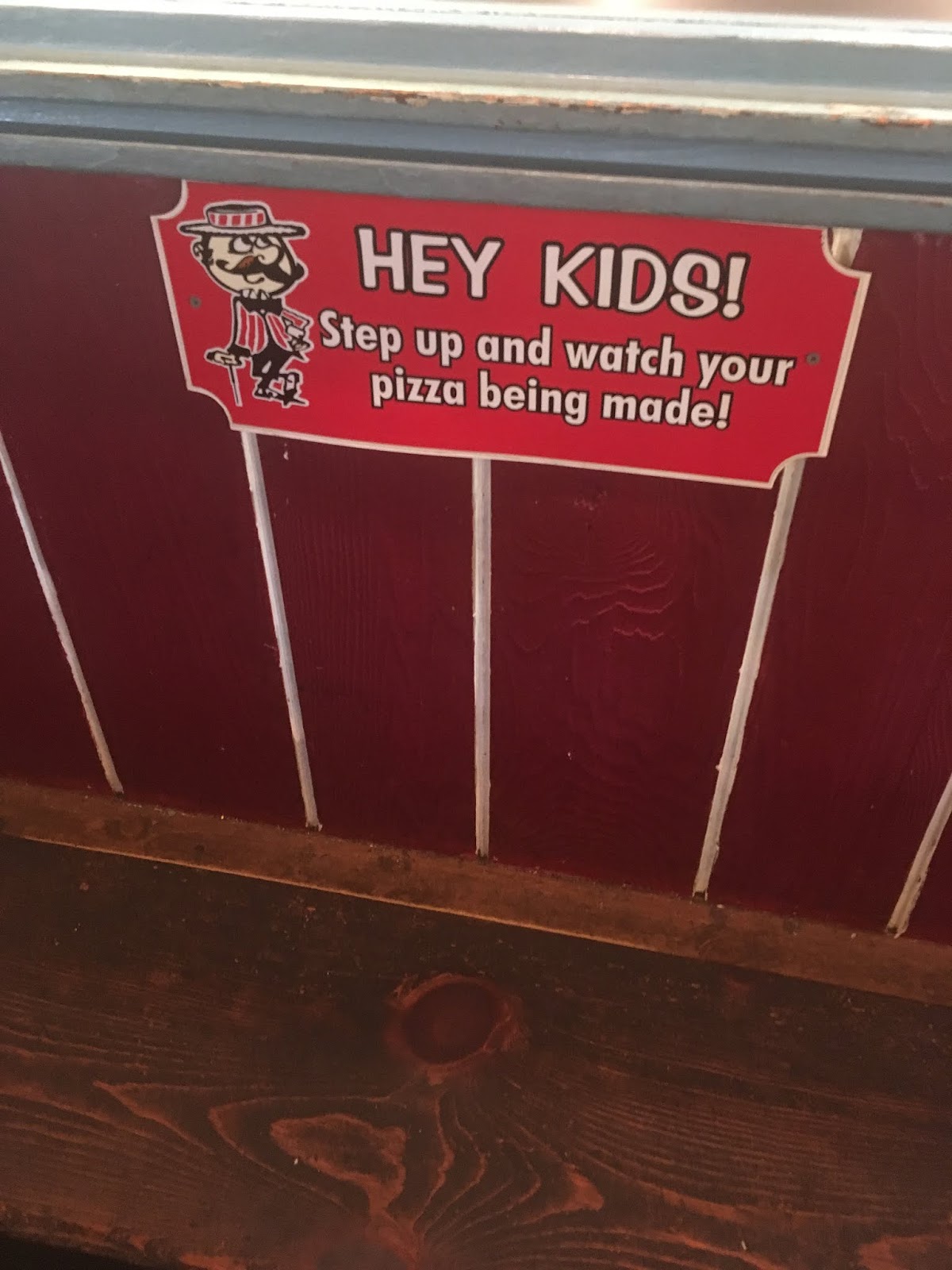
There were several other signs that started with, "Hey kids!"

I was a bit surprised when I got the bill, as my Stromboli, salad, and diet brown soda set me back nearly $20 before a tip for my server, but the economics of pizza tend to favor large groups sharing several large pies over a lone diner eating a single pizza pouch. On my next trip to Pappy’s having a few friends along to help me sample different pizzas and entrees would no doubt result in a better experience, though finding a handful of well-wishers willing to ride along with me to Western Pennsylvania for a meal might be too tall an order for most, if not all of my friend group. 

I need to figure out if I can still join Pappy's Birthday club. 

After paying my bill, I took a quick lap of the dining room to ensure I was fully appreciating the Pappy’s experience. I walked past the window into the kitchen that allowed me to look at employees shaping and topping circles of pizza dough, through the Rax-like solarium that housed an odd grand piano that I regret not taking a picture of, and finally into Pappy’s Fun Zone, a small arcade on the far side of the dining room. I had intended to play a game or two of pinball, but I couldn’t get the old woodgrain-covered change machine to accept my dollar bills. I did at least manage to appreciate the Tiffany-style Pappy’s lamp that hung from the ceiling. It was the only one in the place, but I suspect there were more at one time. It’s the kind of unique branded decor that collectors drool over and dream about hanging over their kitchen tables. (I’m talking about me. I’m “collectors!”)

I'm Pappy. Welcome to my fun zone!


This lamp is the kind of thing that would fetch a few hundred bucks on eBay. 

After the death of the elder Edith Bouvier Beale in 1977, her daughter would eventually sell the dilapidated Grey Gardens estate with the stipulation that the house not be demolished. The buyer, Washington Post editor Ben Bradlee, spent what was sure to be an obscene amount of money refurbishing the property to habitable condition, erasing what had been the backdrop to an iconic film in the process. Grey Gardens’ fate served to show that nothing lasts forever in a patinated state, even cultural icons. For all it’s foibles, The Johnstown Pappy’s Family Pub feels special in the way so many broken chain locations do. Each graffitied table, painted Pappy sign, and overflowing terlet, is a little piece of endangered history, and while Pappy’s is an operational restaurant in original condition today, its overall rough condition and the climate of the Pizza Economy at large may mean its days are numbered. I advise anyone nearby with even a passing interest in broken chains to visit Pappy’s while they still can. As Edith the Elder would say, Pappy’s stands on concentrated (sic) ground. 

The only official account of the history of Pappy's Family Pub that I could find. 

If you’re reading this and feel yourself drawn to surviving outlets of broken chains, consider joining me at the Harlan, Kentucky Rax this November in observance of Raxgiving. Those who attend will learn firsthand that I do terrific dances.