Showing posts with label Mascots. Show all posts

Monday, August 19, 2019

Pizza for One

♬Cheese by the ton on a Margherita
Just pizza for one, 
And one for pizza
Just me for pie
And pie for me alone. 


Strangers a-souring 
At my wanton devouring,
Extreme gurgitation 
On my Keystone vacation 
Pictures of my Pappy, dear,
On my iPhone, crappy, dear


Yum! Brands announced last week that they’d be closing 500 sit-down Pizza Hut locations and increasing the focus on pizza delivery. It’s a move that is hard to watch for anyone who grew up eating pizza under a distinctively-shaped red roof and behind trapezoidal windows, but it's hardly a surprising move. From the rise of the American sit-down pizza parlor started by Shakey’s in the fifties to the present-day, dine-in pizza experiences have slowly become a rarity. Over the years, people discovered that pizza traveled well in a flat cardboard box, and was the perfect food for a delivery business model. Reducing the overhead and complexity of operating a sit-down restaurant in favor of a carry out/delivery setup made business sense for both parent companies and franchisees, and pizza became the default delivery food in North America. People, in general, seem to prefer to eat pizza at home, and with the rise of delivery services, the idea of enjoying a meal out at an inexpensive restaurant is becoming increasingly antiquated. Is it any wonder then, in a time when Postmates and DoorDash will deliver food to your door from nearly any restaurant, that the largest pizza chain in the world, who has been slowly, but steadily, closing sit-down locations for years to the point that entire blogs are devoted to the phenomenon, is set to close 500 of its remaining dine-in locations en masse? 

My local Hut's days are probably numbered.

With market trends being what they are, it’s tough to make a long-term business case for any sit-down pizza chain, but for anyone who grew up having meals out at Pizza Hut, Shakey's, Godfather's, and innumerable other regional chains and mom and pops, it’s a little sad. However, as with most chain restaurants, there are always holdouts that cling to a bygone era and anachronistic business model in the face of a changing marketplace.

“It’s very difficult to keep the line between the past and the present.” 

That's the standout line of the younger Edith Bouvier Beale in the 1975 documentary, Grey Gardens. The film showed the everyday lives and interactions of an eccentric, reclusive, mother and adult daughter both named Edith Bouvier Beale, living in a derelict mansion in the Hamptons. They had been wealthy socialites decades before, but their failure to adapt to a changing world and their own changing fortunes left them living in squalor and obscurity, clinging to their memories of happier and more prosperous times. I saw the film for the first time recently, around the same time I was studying Pappy’s Family Pub, a suspiciously Shakey’s-like chain of pizza joints that operated In Pennsylvania, Maryland, and perhaps other nearby states in the seventies, and perhaps other nearby decades.  

Ignore the modern vehicles, and this picture would look like it could easily be from the late '70s

Like countless other pizza chains before it, Pappy’s locations gradually closed their doors as Domino's and Little Caesar’s made it increasingly clear that delivery and carryout were the future of the pizza business, but somehow, a single Pappy’s location remains open to this day, standing STAUNCH in the face of a changing pizza business. Based on a tip from a reader (Thanks, Aiden!) I visited the world’s last operating Pappy’s located in Johnstown, Pennsylvania a few weeks ago, and I was delighted to find the line dividing the past from the present was nearly nonexistent there. 

Pappy's Dixieland style of dress seems to be borrowed from the general vibe of the Shakey's Pizza locations of the same era. 

I arrived late on a Friday afternoon, having been run out of East Hampton, New York the previous day because I happened to be wearing red shoes. My costume for the day consisted of my second best Taco Tico T-shirt and a pair of raw denim jeans that I’ve been trying to break in. (The best thing is to wear shorts under the jeans, so if it gets too hot you can take the jeans off and use them as a cape.) I parked at the corner of the expansive parking lot in the shadow of a tall vintage sign featuring the mustachioed cartoon countenance of Pappy himself, who in my made-up mythos of chain restaurant mascots, is likely a blood relative of Uncle John of pancake fame. I pondered whether Pappy and Uncle John were brothers, cousins or perhaps father and son, as I made my way to the fanciful red and white doors of Pappy’s entryway. 

These doors could just as easily lead to Santa's workshop
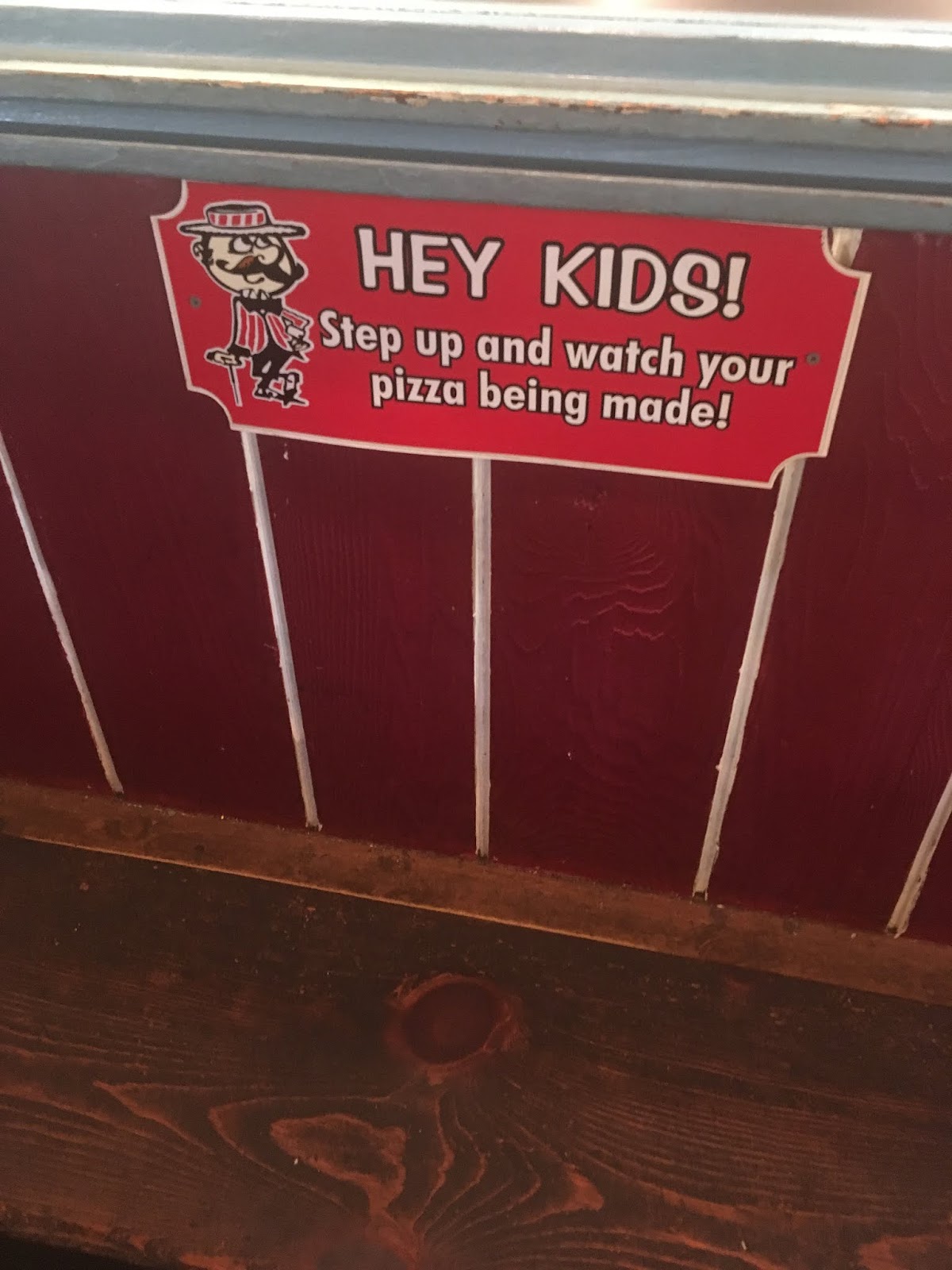
The hostess sat me in one of many well-worn wooden booths, covered in the carved initials of decades of past patrons. My booth was next to a window which was adorned stained glass panels and outlined with round, incandescent light bulbs giving off a faint yellow glow. The dining room was dimly lit by Narnia-esque faux gas lampposts standing at every booth. They appeared to have been modified to include ceramic shades at some point. A fireplace with a brick hearth stood at the center of the room, serving as a cozy focal point, though no fire was burning during my mid-July visit. The dingy red and white paneled walls were adorned every few yards with vintage signage featuring the Pappy, who also bears a striking resemblance to Reddy Kilowatt, if he were to join a barbershop quartet. Aside from a modern internet jukebox on one wall, just about the entire interior of the place looked original, or at least without a significant update in my lifetime. My surroundings made it clear that very little had changed at Pappy's in the past 40 years or so. While I doubt anyone was feeding bags of Wonder Bread to feral cats and raccoons in the attic, the place had clearly seen better days. 

The view to the right of my table...

...and to the left

My booth was not the only one covered in Nixon-era graffiti. In fact, all the booths and tables along with several spots on the walls were similarly defaced. Tiles of the drop ceiling were stained and mismatched. I was seated near the restrooms, and every few minutes, a waitress would check the ladies’ to make sure it was clear before ushering a marble faun of a male plumber through the door, presumably to deal with some horrific plumbing issue I’d rather not be thinking about while ordering dinner. 

"Up your nose with a rubber hose!"


Pizza and so much more!


I examined the menu, and found that it had much more than pizza. I found that I could order ribs, fried chicken, or a steak in addition to the expected pizza and pasta. Could the diverse menu offerings have helped this Pappy’s survive the decline of sit-down pizza joints? I had set out to order pizza for myself, but I was travelling alone as I often do, and no personal-sized pizzas were offered. I settled on a meatball Stromboli (it was pizza-esque, at least) along with a side salad. 

So-so salad; This picture was hastily taken after the first couple of bites. 
The salad was the epitome of nothing special, salad mix from a bag with a couple grape tomatoes and cucumber slices tossed on with a handful of croutons as an afterthought, though it came in a wooden salad bowl, something I haven’t seen at any restaurant in at least two decades. It made me wonder how and if they kept it clean. 

Stromboli, note the meatballs peaking out the vent holes. 
My Stromboli arrived a few minutes later, and as promised by the menu, the baked half moon shaped pizza dough pocket was overstuffed with tiny meatballs, that appeared to be the type that come pre-cooked and frozen. Pizza cheese and a sweet tomato sauce were also present. It wasn’t bad, but a little monotonous to eat. Its flavor and texture could have benefited from some onions and peppers. I’d ask for them to be added if I ordered it again. Still, I had my Stromboli, loved it, masticated it, chewed it and had everything I wanted.

There were several other signs that started with, "Hey kids!"

I was a bit surprised when I got the bill, as my Stromboli, salad, and diet brown soda set me back nearly $20 before a tip for my server, but the economics of pizza tend to favor large groups sharing several large pies over a lone diner eating a single pizza pouch. On my next trip to Pappy’s having a few friends along to help me sample different pizzas and entrees would no doubt result in a better experience, though finding a handful of well-wishers willing to ride along with me to Western Pennsylvania for a meal might be too tall an order for most, if not all of my friend group. 

I need to figure out if I can still join Pappy's Birthday club. 

After paying my bill, I took a quick lap of the dining room to ensure I was fully appreciating the Pappy’s experience. I walked past the window into the kitchen that allowed me to look at employees shaping and topping circles of pizza dough, through the Rax-like solarium that housed an odd grand piano that I regret not taking a picture of, and finally into Pappy’s Fun Zone, a small arcade on the far side of the dining room. I had intended to play a game or two of pinball, but I couldn’t get the old woodgrain-covered change machine to accept my dollar bills. I did at least manage to appreciate the Tiffany-style Pappy’s lamp that hung from the ceiling. It was the only one in the place, but I suspect there were more at one time. It’s the kind of unique branded decor that collectors drool over and dream about hanging over their kitchen tables. (I’m talking about me. I’m “collectors!”)

I'm Pappy. Welcome to my fun zone!


This lamp is the kind of thing that would fetch a few hundred bucks on eBay. 

After the death of the elder Edith Bouvier Beale in 1977, her daughter would eventually sell the dilapidated Grey Gardens estate with the stipulation that the house not be demolished. The buyer, Washington Post editor Ben Bradlee, spent what was sure to be an obscene amount of money refurbishing the property to habitable condition, erasing what had been the backdrop to an iconic film in the process. Grey Gardens’ fate served to show that nothing lasts forever in a patinated state, even cultural icons. For all it’s foibles, The Johnstown Pappy’s Family Pub feels special in the way so many broken chain locations do. Each graffitied table, painted Pappy sign, and overflowing terlet, is a little piece of endangered history, and while Pappy’s is an operational restaurant in original condition today, its overall rough condition and the climate of the Pizza Economy at large may mean its days are numbered. I advise anyone nearby with even a passing interest in broken chains to visit Pappy’s while they still can. As Edith the Elder would say, Pappy’s stands on concentrated (sic) ground. 

The only official account of the history of Pappy's Family Pub that I could find. 

If you’re reading this and feel yourself drawn to surviving outlets of broken chains, consider joining me at the Harlan, Kentucky Rax this November in observance of Raxgiving. Those who attend will learn firsthand that I do terrific dances.


Tuesday, January 22, 2019

Oh, What They've Done to the Chili!

Kiss my grits, Mel!

The past few days have been the coldest so far of the winter in my Metro Detroit home. This past weekend, the abysmally frigid temperatures sapped my motivation to leave the house, and saw me remaining at home for all but the most necessary outings. I passed the the time watching reruns of Mama’s Family and Night Court on my 1980-vintage 12 inch black and white Philco TV, onto which I recently connected the necessary adapters for it to pick up the digital broadcast signals from the local stations, many of which air programming that is period appropriate to the very device I’m watching on. These days, nearly all of my television viewing is done using various streaming services which allow me to watch any of their offerings whenever I want. It seemed like an eternity since I sat down and channel surfed until I found something that I could watch that happened to be airing independently of my schedule.

From what I saw, it appears everyone under the age of 70 also abandoned so-called “appointment TV,” because the commercials that aired between the reruns were targeted squarely at the elderly. As I sat through the endless commercials for term life insurance, hearing aids, and scammy reverse mortgages, I was reminded of a much warmer day a month or so back. Counter-intuitively, I was in Minnesota, and it was the Winter Solstice.

I’d been driving around The Land of 10,000 Lakes all day, having dined at both the Zantigo in St. Paul and the Bonanza in St. Cloud. My last Minnesota meal of the day came around 3 PM, an hour or so before sundown on the shortest day of the year. I was in Mankato at the last operating Happy Chef Restaurant.

Like Sign of the Beefcarver back in Michigan, the lone surviving Happy Chef was also the very first location, opening in Mankato in 1963. The chain grew to around 80 units in Minnesota and surrounding states. Downfall came in the ‘80s as the Happy Chef brand grew increasingly dated with each passing year, and failed to adapt to a younger clientele. Locations began to slowly close, leaving only the original location in Mankato open.


The first thing anyone who visits the Mankato Happy Chef will notice is the titular chef character out front. The sheer size of the statue puts even the biggest Big Boy to shame. The Happy Chef stands with a wide grin, holding a massive wooden spoon skyward, and gesturing toward the door with his other gigantic fiberglass hand. He towers over the building, despite being severely bowlegged, attracting attention from everyone driving by on highway 169 as he has for more than 50 years. Local newspaper articles claim that the long dormant speaker system that resides within the bowels of the chef had recently been restored to operating condition, allowing him to shout pre-recorded phrases at passers-by. Maybe I didn’t walk by the correct spot to trigger the system’s motion sensor, or maybe there was a malfunction, but on the day of my visit, the Happy Chef had nothing to say to me. 


When I walked inside, the lone waitress said I could sit anywhere. I chose a booth near the kitchen in the surprisingly small dining room. Aside from myself and a table of six or so active seniors, the place was empty. The decor felt, dated, and surprisingly bland, given the 30 foot chef out front. The atmosphere had an inoffensive pastel late 1980s palate, like a cheap nursing home. As the table of oldsters next to me discussed their views on the current political climate and provided to one another various graphic descriptions of their respective physical maladies, all in accents that made them sound like bit players in some long forgotten deleted scene from Fargo, I thumbed through my menu and found it to be full of typical American diner food.

The view from my table, dated, clean, inoffensive

The overflow dining area could pass for the rumpus room at grandma's.


When my waitress returned, I ordered up the most distinctive food I could find on the menu, a pork tenderloin sandwich, a cup of chili, and a glass of Rochester Root Beer, a brand I hadn’t encountered before or since. A few minutes later, my order arrived, and my waitress offered me a ominous “Good Luck” as she gestured toward my sandwich whose breaded meaty innards extended several inches past the bun in all directions. I proceeded to fold the porcine patty into thirds like a deep fried wallet and add some of the tangy barbecue sauce and vegetable garnishes from my plate to the sandwich before taking a bite. As pork tenderloin sandwiches go, this was a good one. The breaded hunk of swine in the middle had been prepared from scratch and was moist without being fatty or chewy. Likewise, the Rochester root beer was pleasantly sweet and thick with strong notes of vanilla and sassafras. Rochester must be a root beer that is marketed strictly toward the elderly, though, as there appears to be no information about them anywhere on the internet. Likewise, the chili was clearly formulated for the geriatric palate. 

"Good luck"
The crackers were the spiciest thing in this chili. 


Actually, to call it chili would be generous, since both cumin and chili peppers are requisite ingredients for chili. I tasted no notes of either in what was essentially a tomato, beef, and bean stew. I'm not even certain salt was added to it. While the chili was the definite low point of my meal, it was, like my surroundings inoffensive, if bland. Like much of the rest of Happy Chef, the unnervingly mild chili appears to have been concocted to cater to a clientele with an average age of 85, whose digestive systems a spicier blend might not agree with. Still between Happy Chef and Zantigo, I'm beginning to realize why Minnesota isn't known for its chili. 

While I'm a solid 40 years younger than Happy Chef's target demographic, I'm glad I got to experience it, and take a step back into the past while dining with people who may well have been eating at that very Happy Chef since it opened. While the experience wasn't terribly unique, it was comforting, like a day spent watching bad TV while swaddled in a couple heavy blankets as snow gently falls outside. Just as are better ways to watch TV, than connecting the rabbit ears to the old Philco, there are better restaurant chains than Happy Chef, whether they be thriving or broken, if you're not too set in your ways to seek them out. However, when you're in the right mood, a bowl of mediocre chili or a few hours in front of a tiny, ancient cathode ray tube, can be immensely comforting. 


Anyone who can tell me piece of culture the title of this post is referencing will receive an imaginary high five from me.

(Yes, I stole the obscure cultural reference shtick from Judge John Hodgman. What's he going to do, sue me in his imaginary internet courtroom?)

Also be sure to check out the Broken Chains Facebook Page, where I announce new posts, and post occasional bonus content. 

Monday, December 17, 2018

Uncle John's Stand


I occasionally fear that I’ll run out of new places to visit that fit the broken chain archetype that I like to experience and write about. Indeed, I’ve often found myself traveling increasingly long distances in pursuit of experiences with the surviving outlets of diminished and defunct brands. In an attempt to stave off the day that I run out of undiscovered broken chains, I constantly keep an eye out for new places to visit, both nearby and thousands of miles away. Almost a year into this ridiculous endeavor of mine, I was encouraged that I was far from running out of material when I heard of a nearby broken chain that I didn’t previously know existed.

I often find myself in Toledo, Ohio, hanging out with my friend and fellow Ford Festiva enthusiast, Bo-Luke Coyvance. It was Bo-Luke that tipped me off when he found out through a Facebook post that what he thought to be was an independent breakfast and lunch place in Toledo was indeed a holdout location of a broken chain. Uncle John’s Pancake House sits just off I-475 in Toledo, on Secor road. (I always get a giggle when I see signs for Secor Road since it shares its name with the fictional laxative manufacturer from Mad Men.) Information about Uncle John’s history is scant, but I pieced enough together to know the first location opened in Santa Barbara, California in 1956 before expanding nationally. I also found passing references to former locations in Arizona, Florida, Pennsylvania, and Michigan. There’s not much information about what caused the brand’s downfall, but I like to think the chain’s decline came when Uncle John abandoned the restaurant business to start a band, which often played both by the riverside and to the tide. Near as I can tell, there are two Uncle John’s Pancake House locations open today, the one on Ex-Lax Avenue in Toledo, which opened in 1963, and another in Campbell California which seems to have opened in the past few years in an attempt to revive the brand on a local basis.

A relic from the good old days when men wore plaid, and children had facial hair.

It’s tough for me to not drop everything and jump in the car when I hear of a charmingly outdated chain restaurant 500 miles away, but the prospect of such a place a little more than an hour down the road was too much to resist. I left the house at 5 AM this past Saturday so I could beat the weekend breakfast rush to Uncle John’s and appreciate a little living history without the din of a crowd. Thanks to it being mid-December, it was still well before sunrise when I arrived, and I was able to see the original neon signs (almost) completely lit. A framed stained glass portrait of Uncle John greeted me in the building’s entryway. He stood, exuding avuncular style in his plaid suit and handlebar mustache, among his various young niblings who all held balloons and had mustaches of their own. I would come to find out that in the chain’s heyday, they’d supply children with their own false mustaches so they could emulate Uncle John.


Page 1: Just Pancakes

Page 2: Mostly French toast and waffles


I stood around the small lobby for a while before a busy waitress told me I could sit anywhere. I followed the long racing shell rowboat hanging from the ceiling to a quiet booth near the center of the dining room. The place was decorated in the “nail random crap to the wall” style that you might see at a Cracker Barrel or TGI Friday’s, but something about it feels more authentic here, as if many of the items on the wall were acquired over the course of the restaurant’s 55 year existence.

I sat under the stern of the ceiling boat. 


Random crap on the walls.
Random crap continued, even a different Uncle John


The same busy waitress, came by with a menu and took my drink order shortly after I sat down. I was impressed with the selection of pancakes offered, which occupied the entire first page of the menu. Likewise, the second page was mostly taken up by other syrupy breakfast delights like French toast and waffles. I read no further because I didn’t need to after I saw pecan pancakes, which I ordered along with a side of bacon.
Classic syrup caddy.


The table had four different syrup containers with IHOPesque flavors, maple, butter pecan, boysenberry, and strawberry. I intended to try all four, but I didn’t make it past butter pecan when my order came. The sweet and rich butter pecan syrup was the perfect compliment to the warm pancakes with pecan pieces both inside and on top. It was the symphony of pecan flavors that I imagine a Stuckey’s pecan milkshake to have been. The bacon was a bit of a letdown. While of a decent quality, nicely cooked, straddling the line perfectly between chewy and crispy, it was cold, perhaps even a bit colder than room temperature, as if it had taken my overworked waitress too long to pick it up from the kitchen. Regardless, it was better than the bacon at my local IHOP, which usually comes out of the kitchen not only cold, but also overcooked. 

Excellent pancakes, thermally challenged bacon.

If the other patrons are receiving cold bacon, they weren’t complaining. Everyone here seems to be in a great mood. A group of about ten well-dressed young adults behind me is laughing uproariously at an unironic Borat impression by a member of their group. (It was far from “Very niiice!”) An elderly couple sits near the door, and appeared comfortable and content, as if this has been their Saturday morning routine for decades. A man I took to be at least down on his luck, if not homeless sat in another booth and seemed pleased when the one and only waitress told him that another patron had already paid for his meal. Short staff, cheesy decor, and cold breakfast meats aside, something about this place put everyone in a good mood, myself included. 


I’m drawn to places that offer memorable and unique experiences. It’s why I love the Art Deco aesthetic of G.D. Ritzy’s and the time capsule that is Sign of the Beefcarver. The upbeat atmosphere and touches that date to the chain’s heyday make Uncle John’s Pancake House a place I’m glad to have experienced. I’m glad to have visited, and will be back often. I’m continually surprised at what still exists out there, and I’m immensely thankful I was able to experience the last continuously operating link in an under-documented and nearly forgotten chain.


I was recently a guest on episode #0487 The Stuph File Program, a podcast hosted by Peter Anthony Holder. You can hear the episode I was on here, or on your podcatcher of choice.

Be sure to like the Broken Chains Facebook page to receive updates about new blog posts and see additional content occasionally.  

Monday, December 3, 2018

Raxgiving


In America, fourth Friday in November is the unofficial beginning of the holiday shopping season. At big box stores and malls all over this land, folks line up outside the night before, sometimes setting up lawn chairs and tents, hoping to be early enough in the door in the morning to be one of the lucky few to get the pre-bait and switch “doorbuster” price on the season’s hottest new rooty-toot-toot or rummy-tum-tum. The event is an easy target for criticism by columnists, bloggers, and anyone seeking likes and shares on the socials, but the people that bemoan the frenzy of consumerism that marks the day after Thanksgiving seldom offer any alternatives to make the day pleasurable and memorable.

The consumer observances that follow the infamous Friday in late November all seem to have been created as a response to it. Small Business Saturday reminds us to support our local independent merchants. Cyber Monday is when online retailers seek to compete with brick and mortar stores by offering deep discounts on popular merchandise, and Giving Tuesday serves as a prompt to support our favorite charities. The broken chains, not technically small businesses, since they’re part of larger brands, and still decidedly for-profit, so not charity cases either, somehow get lost in the shuffle, and are not known for offering significant discounts following the Thanksgiving holiday. I aim to remedy that, by replacing Black Friday shopping with a new holiday that I like to call Raxgiving.

Rather than standing in bitter cold and enduring numerous aggressive shoppers in a crowded, chaotic store as fluorescent lighting, Bing Crosby and Mariah Carey assault your senses immediately after you’ve been roused from three hours of sleep on a too-small twin bed in your childhood bedroom, exhausted from having cooked and eaten a literal feast, all the while barely tolerating the various Cousin Eddie types that make up your extended family, I humbly suggest an alternative. Instead of abusing your body and mind by taking part in competitive shopping immediately following Thanksgiving, take a break. Get a full night’s sleep, and make an excuse to take a few hours to yourself. Use that time to visit a nearby (or not so nearby) outlet of a struggling, near defunct, or otherwise diminished chain, and buy yourself a nice meal, an ironic T shirt, or a few cans of marked down cranberry sauce, whatever they’re selling at the place where you end up. The business will appreciate your patronage more than the crowded big box store up the street, and in turn, you’ll have a  recharging experience in an atmosphere that is likely to be quiet, relaxed, and charmingly outdated.

To understand why the day is called Raxgiving, you should probably hear the story of how I celebrated the very first Raxgiving almost two weeks ago so you can share the story with your friends and well-wishers. It goes like this:
Even in the '80s when there were 500 Rax locations, this one would have been a contender for best view. 

I awoke in the spare bedroom of my parents’ house in Central Kentucky, having spent the past two days driving down from Michigan and preparing essentially the entire Thanksgiving meal, which incidentally, included pecan pie made with Stuckey’s pecans. After two solid days of family time and generally making Thanksgiving happen, I was ready for some alone time, so Friday morning, I pointed my car toward Harlan, Kentucky, home of the one operating Rax location I had not yet visited.


The Harlan Rax had been on my list to check out for months. Along with the Joliet, Illinois Rax, it’s one of only two Rax locations that has a functioning salad bar, and is the last operating Rax in the Bluegrass State. With its view of the Appalachian mountains out the solarium, it’s also a strong contender for the most scenic Rax location.


I arrived late in the morning, and after taking the time to appreciate the largely unmodified ‘80s vintage building and signs, walked in. Like the other Rax that retains its salad bar, the Harlan location has ‘90s vintage signage and menu boards. One panel of the latter advertises a hot food bar on Friday, Saturday, and Sunday for $10 including a drink. Knowing I can get a BBC sandwich or barbecue cheddar potato at any of the four Rax locations in Ohio, that do not offer salad bars, I opted instead for the unique hot food bar, which also included access to the every day salad bar.


Just as in Joliet, a nicely stocked, tidy salad bar awaited me. Rather than the taco meat I encountered in Joliet, though, this Rax offered fried fish, on its hot food bar along with homemade soups, beans and cornbread, and fried potatoes, most of which I sampled. I suspect the hot food bar menu varies day to day. I’ll have to plan a trip here on a Saturday and/or Sunday to get the full hot food bar experience. The food was unimportant compared to my surroundings however. 

First course from the Endless Salad Bar; I went for variety

Second course; This soup was made from scratch

The third course tasted better than buffet fish had a right to. 

Replace that flatscreen with a fuzzy CRT, and this picture could be from 1985. 
Of the six surviving Rax locations, this one feels the most authentic. Like the Ironton and Lancaster, Ohio locations, it’s a purpose-built 1980’s era structure with the signature long, narrow windows running down the sides of the building and the classic Rax solarium in the front, but unlike its counterparts in Ohio, this location makes use of vintage signage and has a fully functional salad bar and buffet. The Joliet Rax has a salad bar and buffet as well, but is housed in an older building which was built in the era when Rax was known as Rix, and while it’s immensely interesting building, it’s had some interior upgrades and doesn’t feel as authentically Rax. The Harlan Rax on the other hand, retains most of its original fixtures and furniture, aside from some patina here and there, it’s largely as it was three decades ago. It’s a truly amazing working museum exhibit that exemplifies the Rax “Fast food with style” motto. 

I'd guess this sign has been on the wall for at least 20 years. 

Finding the Raxiest Rax, and completing my travels to every operating Rax location is cause for celebration, hence my suggestion of the yearly observance of Raxgiving. While Raxgiving can be spent at not just Rax, but a location of any broken chain, certain traditions should be observed. I’ve laid out a few suggestions of Raxgiving traditions below:

  • Whatever broken chain you visit on Raxgiving, be sure to spend money there. Your patronage keeps the broken chains in business for others to enjoy.
Support America's favorite sandwich place so all of America may enjoy it. 

  • Immerse yourself in your surroundings and revel in the uniquely anachronistic customer experience a broken chain provides.
    A drinking fountain in a fast food place? How crazy is that? 
  • Visiting a broken chain by yourself isn’t mandatory. If you have friends or family around for Thanksgiving that you’d like to spend some additional time with, invite them along to make a memory.

    For instance, I met up with my uncle at Rax. He happens to be an alligator.
  • Remember to take the time to honor the memory of any former locations you encounter along the way.
I spotted this Arby's in Corbin, Kentucky on my return trip. If you look closely, you can tell it began life as a Rax. I paid my respects by using their bathroom and buying a chocolate shake. 


So that’s my modest proposal for the next trendy new unofficial post-Thanksgiving holiday. If you plan on celebrating next year, start planning soon. As of the time I’m posting this, there are only 361 days left until next Raxgiving.