Monday, September 9, 2019

Rippin' Off the Ritz?


American Dennis
British Dennis

If the analytics tool I use to monitor page views for this blog is correct, approximately 82% of the recent readers of Broken Chains access it from a device with an American IP address. Another 2% access Broken Chains using a device with a British IP address. One could make any number of educated assumptions based on this data, but the assumption relative to today’s topic is that approximately 84% of the recent readers of this blog are familiar with a character known as Dennis the Menace. What might surprise the average American or British Broken Chains reader is that Dennis the Menace is a name used by two similar, yet distinctly different characters on either side of the Atlantic. 

Two separate cartoonists created each character, who share a name, a tendency to cause mischief, and a penchant for horizontal stripes. While American Dennis and British Dennis have a few differences, British Dennis is a few years older and is more of a troublemaker than his American counterpart who is younger and usually well-meaning, but inadvertently menacing. The similarities are striking. Surely, one must be an imitation of the other, right?

The last G.D. Ritzy's mascot sign in use, Huntington, West Virginia

I make no secret for my love of the down, but not out G.D. Ritzy’s restaurant chain that once boasted 120 locations. My enthusiasm for Ritzy’s and their surviving locations was a major catalyst that drove me to start this blog in the first place, along with some strong encouragement from my friend, Cosmo Roadpacer. Last spring, I visited all six of the loosely affiliated surviving locations, plus a seventh that would open the following fall. Not long after that, I had a G.D. Ritzy’s logo tattooed on my right arm. I was predictably interested when I learned of a nearly extinct restaurant chain that used a similar name and seemed to predate my beloved G.D. Ritzy’s by several decades.

Ritzee Hamburgs, Battle Creek, Michigan

Ritzee Hamburgs in Battle Creek, Michigan is the last surviving location of a local chain that once had multiple locations in Battle Creek, plus a few others in nearby, Jackson, Grand Rapids, and perhaps also Kalamazoo during its 1950s heyday. Given that imitation runs rampant in the fast food industry, whether it be Kewpee’s influence on Wendy’s or Big Boy’s influence on the Big Mac and Big Shef, I was curious to see if Ritzee Hamburgs had any direct influence on the similarly-named G.D. Ritzy’s, which began in Columbus, Ohio in 1980, well after the heyday of Ritzee Hamburgs. 

I suspect the sign predates the building. 

I found my way to Battle Creek early on a Friday evening en route southwest to Indiana. I parked in the shadow of the tall, angular neon sign advertising 79 cent burgers, and walked toward the imposing brown facade of the building adorned with hand painted signage. When I entered the building, it was clear it had received few updates since the 1970s. The booths were covered in harvest gold Naugahyde, and potted plants hung from the ceiling in macrame holders. That same ceiling was adorned with curious faux stained glass, faux skylights, while the floor was covered in the same faux woodgrain tile that I recall seeing in 1970s-built McDonald’s locations. The spartan menu board appeared era-appropriate to the rest of the dining room, and the drinks section included “imitation lemonade,” a drink just as authentic as the skylights. While the interior of Ritzee Hamburgs was equally dated as the practice of calling burgers “Hamburgs,” nothing looked to be alarmingly dirty or in disrepair. As with many of the places I visit, Ritzee was stuck in time.

The menu is anything but ritzy...

...but the dining room exudes all the 1970s luxury of a Chrysler Cordoba.

To anyone over the age of 30, these are McDonald's floor tiles. 

I ordered up a Ritz cheeseburger with everything as well as an olive burger, plus fries. (I don’t especially enjoy olive burgers, but I encounter them frequently when traveling in western Michigan. I order and force myself to eat one every so often in hopes that they’re an acquired taste.) After ordering, I took a seat, and took a few minutes to bask in the anachronistic majesty of my surroundings. It was a brief bask, though as my food was delivered quickly to my table on actual ceramic plates. 

That's an olive burger all right. 

Here's a conventional Ritzee burger.

I was curious if the burgers would bear any resemblance to those at G.D. Ritzy’s, and while both chains refer to their quarter pound burgers as a “Ritz” that’s where the similarities ended. The Ritz cheeseburger before me had a relatively thick, circular patty on a sesame seed bun. “Everything” at Ritzee means mustard, ketchup, pickle and onion. The fries were standard crinkle cuts, and the olive burger was… covered in green olives. While the food was decent enough, it was clear that G.D. Ritzy’s thin, irregularly-shaped, lacy-edged burger patties smashed flat on a ripping hot grill, on unseeded buns topped with lettuce, tomato, and mayonnaise in addition to ketchup, mustard, pickle, and onion had no direct relation to the burgers at Ritzee Hamburgs. Likewise, the crinkle cut fries at Ritzee had no resemblance to G.D. Ritzy’s shoestring fries. Ritzee also lacked the peanut butter and jelly sandwich, made from scratch ice cream, and Art Deco theme that make G.D. Ritzy’s feel fun and unique. Satisfied with the lack of similarity, I finished my meal, bused my table and walked out the door through the parking lot to my car, thinking there couldn’t possibly be a direct connection between Ritzee Hamburgs and G.D. Ritzy’s, when I saw it, another hand painted sign by the door featuring a fancy man with a mustache monocle, top hat and tuxedo who bore a striking resemblance to G.D. Ritzy’s mascot who wore a bowler hat, and in his earliest incarnations also had a monocle and mustache. Could the Ritzee Hamburgs fancy man have been the inspiration for the G.D. Ritzy’s fancy man? It at least seemed possible. 

Ritzee fancy boy
Early G.D. Ritzy's fancy boy,
note the mustache and monocle

In the US, Dennis the Menace comic strips first appeared in newspapers on March 12, 1951. Across the Atlantic on the very same day, issue 452 of the comic book, The Beano were on sale at newsstands all over the UK, a few days ahead of their March 17th issue date. Those comics were the first to feature the British Dennis the Menace. That’s right, both Dennises the Menaces first appeared on the very same day on different continents, created by different cartoonists for different publications, none of whom knew about the other Dennis. By all accounts, it was a complete coincidence. These kinds of coincidences happen occasionally in the chain restaurant world, notably to Waffle House and Burger King. Based on my experience at Ritzee Hamburgs, it seems likely that the similarities in name and mascot were at least mostly coincidental.

According to Wiktionary, the word "Ritzy" describing something elegant or luxurious is an eponym derived from the name of Swiss hotelier César Ritz, founder of the high-end hotels known today as Ritz-Carltons. The name of both restaurant chains is therefore likely to have a common etymological ancestor in César Ritz. Additionally, the disappearance of the monocle and mustache from the G.D. Ritzy's mascot implies that the operators of that chain at least gained an awareness of Ritzee Hamburgs. I tend to assume the original G.D. Ritzy's was created with no awareness of the similar Ritzee mascot, after all, what makes a fellow look ritzier than a monocle and mustache? Adding them seems like a decision that was reached organically in the case of both chains. I do however, suspect that at some point G.D. Ritzy's management became aware of the pre-existing Ritzee Hamburgs mascot and removed the mustache and monocle from their own mascot to prevent the possibility of finger pointing or worse, litigation.

A hamburger for under a dollar is as hard to find as a sit-down Pizza Hut.
I was on my return trip from points west of Battle Creek with this post fully written in my head, when it occurred to me that I hadn't tried the 79 cent burgers advertised on the ancient sign out front of Ritzee. I stopped by as an afterthought to see how much burger 79 cents would buy in 2019, this time ordering via the drive thru. While the burger I received was a little light on meat and heavier than bread than is ideal, it has way more of both than what you'd find on a White Castle slider, which costs a few cents more. It's the ritziest sub-one dollar burger I've encountered in this decade, and like every other menu item at Ritzee Hamburgs, it's also completely unlike anything at G.D. Ritzy's, mascots aside. 


If you'd care to join me in an in person discussion over food that is strikingly similar to what you'd find at Arby's, consider coming to Raxgiving at the Harlan, Kentucky Rax this November. I'll be there to hang out with readers of Broken Chains in a thematically appropriate setting.


Broken Chains on Facebook 

Broken Chains Store


Thursday, August 29, 2019

It's the '90s!

It's more than just a movie, it's a big night out! (clap clap clap)

Not long ago, I was idly sitting around doing nothing of great importance as I often do, when I had a random flashback to my adolescence. I was in seventh grade, engaged in a conversation with my best friend, Zeke Hertfordshire that was rife with the kind of one upmanship that is the specialty of thirteen year olds. We were debating who was capable of eating more, and it was Zeke's assertion that he successfully consumed two Garbage Burgers at Max and Erma’s that shut me up. At the time, I had never eaten at a Max and Erma’s, and had no idea what a Garbage Burger was, but it sounded sufficiently large and disgusting to successfully rebut my previous argument that involved a gluttonous, glutenous, outing to a KFC Colonel’s Buffet.

My recollection about that friendly, but decidedly childish argument got me thinking about Max and Erma’s. Nearly all of the locations near me closed a few years ago. The only one I could recall seeing in business recently was in the Delta terminal at the Detroit Metro Airport. A little research revealed Max and Erma’s is indeed a broken chain. There are 25 locations in operation, more than half of which are in Ohio. The rest are in surrounding states with the exception of two outposts near Virginia Beach, though like all broken chains, Max and Erma’s empire was once much larger.

Max and Erma's at the airport, because who doesn't love a pre-flight Garbage Burger


Max and Erma’s history began, predictably, with Max and Erma Visconik, who, in 1958, opened a small restaurant bearing their names in a historic building in the German Village neighborhood in  central Columbus, Ohio. The mom and pop operation would continue with a single location until the first in a long series of corporate acquisitions in 1972. That was when Max and Erma sold Max and Erma’s to a pair of businessmen who proceeded to turn the charming neighborhood restaurant into a homogeneous corporate chain. Barry Zacks and Todd Barnum, the new Max and Erma in all but name added a new menu of high end “gourmet” burgers at a time when burgers were nearly exclusively thought of as cheap convenience food. They also implemented the then trendy, and now clichéd “Nail a bunch of random crap to the walls.” theme that included a sundae bar that used a claw foot bathtub as a serving table for some reason.

The chain grew slowly but steadily through the '70s, and '80s, but exploded in popularity in the '90s, the golden age of mid-priced theme restaurants. It was around then that the company briefly experimented with franchising, but ultimately decided to keep all locations corporate owned. The highest location count I can find for the chain is 80 circa 2009, but I suspect Max and Erma’s peaked earlier, and with closer to 100 locations, as they once operated as far from Columbus as North Carolina and Kansas, areas where they have no presence today. Trouble came for the chain amid recession in 2008, when the brand was sold to a Pittsburgh-based private equity firm who, in turn, declared bankruptcy a year later. The Max and Erma’s brand then bounced around between owners shedding locations steadily, often closing multiple locations overnight with no notice to employees. A recent wave of closures in 2017 included the original German Village restaurant.

With my curiosity piqued, I found my way to the nearest Max and Erma’s location that did not require me to buy a plane ticket and stand in a security line to dine there, though my journey to that Max and Erma’s did require me to enter a time portal that took me back to the mid 1990s.

The only Max and Erma’s in Michigan that’s not in an airport is located in Clinton Township in the Partridge Creek Mall. Partridge Creek is an anomaly among Michigan malls for myriad reasons, but chief among them is its lack of indoor corridors. While the configuration is common in warmer climates, an outdoor lifestyle center-style mall stands out in a region that regularly receives heavy snowfall and brutal cold. The mall employs portable propane heaters in the winter to keep shoppers comfortable, but no outdoor climate control was necessary during my late August visit.

I made the trek to Partridge Creek on a Sunday evening, expecting the mall to be largely vacant of both retail tenants and shoppers. Upon parking and entering the mall near its MJR theater, I was surprised to see a healthy, vibrant retail space, full of moderate to high end shops and packed with patrons who seemed to be enjoying both the space and the near perfect weather as they milled through the mall’s roofless corridors. There was even a live band performing on a stage at the mall's center court. I travel frequently and often visit malls and other retail spaces, and I can confidently say that this was the largest crowd I’ve seen at any mall outside of the holiday shopping season since my adolescent years wandering around Fayette Mall in Lexington, Kentucky back when it still had a Natural Wonders and long before it’s food court caused a norovirus outbreak. Since the common areas of the mall were technically outdoors, one out of every twenty or so people was enjoying a cigarette as they shopped. It had been even longer since I had seen anyone smoking in a retail space. The combination of visiting a thriving crowded mall where people could smoke freely made me forget about the lack of a roof over my head and took me right back to every shopping trip to Fayette Mall I was dragged along for in the 1990s, despite the fact that Partridge Creek didn’t open until 2007. The illusion continued when I navigated the open-air labyrinth of shops and found my way to the stained glass and stone facade of Max and Erma’s.

Max and Erma's at Partridge Creek

It was clear Max and Erma’s corporate architecture and interior decor guidelines have not had significant updates since their Clinton-era heyday. The guitars, vintage signs, and giant fiberglass hamburger lining the walls had clearly been dreamed up more than twenty years ago. To complete the illusion, Aerosmith’s “Livin’ on the Edge” played over the PA speakers as the hostess showed me to a booth near the door.
The menu was a single page...
...but double-sided.


At that point, the ‘90s had taken hold. I could only speak in the vernacular of the time. I replied, "Rad!" When my waitress introduced herself and “Awesome!” after she took my order, which included a Garbage Burger, a hamburger I had not discussed with another human since that conversation with Zeke in 1998. 

I don't recall Pink Shirt Guy dancing under the giant burger, but photos don't lie. 

Despite the restaurant being about ¾ full, a surprisingly large crowd for a Sunday evening, my order was delivered to my table in around 10 minutes, and the Garbage Burger stood before my in all of its glory, a marvel that I had subconsciously anticipated beholding for over 20 years. It was impressively presented with the crown of its bun off to the side to showcase the grilled onions and mushrooms, bacon, guacamole and marinara that covered the half pound patty. Steve Urkle would also be glad to know the Garbage Burger was topped with two kinds of cheese. I hadn’t expected the Garbage Burger to be as photogenic as it was, but it was downright gorgeous, and while not as impressive in today’s burger landscape as it might have been during its 1970s debut and 1990’s prime, it’s still unique by virtue of its varied list of toppings. 

Behold the garbagey glory!

I sat the crown of the bun on top of the foodpile below and gave it the customary gentle squish to help ensure the layers adhered. I was immediately greeted by a viridescent annulus of guacamole unnervingly oozing from beneath the bun. I did my best to stuff it back where it came from using the business end of my fork. In an attempt to mitigate the Garbage Burger’s inherent messiness I opted to cut the whole thing in half. I then lifted the less messy appearing half of the refuse sandwich to try a bite. I was greeted with a beefy, mushroomy flavor that completely overwhelmed all of the other toppings, the runniest of which now coated my hands despite my best efforts. I powered through and finished the first half, and then the second, interspersed with bites of fries indistinguishable from their Chili’s or Applebee’s counterparts, all the while struggling to taste the guacamole or marinara that was dripping down my arms and onto my lap. 

Garbage Burger cross section and runoff; Yes I ordered it rare. I like to live dangerously.

Top your sundae from a tub for reasons. 

When my waitress asked if I wanted more fries, I emphatically responded in the affirmative, but waited a few beats before adding a sudden “Psych!” thereby creating an original and hilarious joke. I instead asked to visit the sundae bar. A few minutes later she returned with a square bowl of hand-scooped vanilla ice cream, which I Macarena’d over to the sundae bathtub, which was complete with ceramic tile walls. I loaded up my bowl with Oreo crumbs, whipped cream, hot fudge, and cherries from the sundae bar that was impeccably clean despite a crowd rife with small children. My self-made sundae felt more premium than a similar treat I’d find at a feeding trough buffet thanks to real ice cream forming its fundament instead of the grainy soft serve that’s pushed out the sphincter of an ancient, wheezing machine at my local Ponderosa. 

My sundae, shown here after a couple of bites, as is tradition.
Just as I was finishing, my waitress returned and asked if I wanted another bowl of ice cream. Like the fries, ice cream is unlimited. I politely declined, stating I was working on my beach body so I could look as fit as David Hasslehoff on Baywatch. I then paid my bill, walked out of the restaurant, as Counting Crows’ “Mr. Jones” punctuated my exit, and retraced my steps back through the mall to the present. Sadly, I had driven my modern vehicle there that day, but on return trips to Max and Erma’s, you better believe I’ll be driving my teal ‘93 Ford Festiva and wearing the neon red Hot ‘n Now jacket I bought on eBay. I should go back while I still can. 

I wasn't kidding about the jacket. Maybe I'll wear it to Raxgiving dinner. 


Partirdge Creek Mall lost one of its anchors when its Carson’s department store closed last year along with all other Bon-Ton owned stores. It’s Nordstrom is set to close in a few weeks. Without the big stores to anchor them, the mall’s smaller in line stores, including Max and Erma’s, are in danger of closing. It’s as though the 90’s are coming to an end all over again, 20 years later, as the specter of the Retail Apocalypse looms Y2K-like, over another endangered mall and an ever-increasingly broken restaurant chain. Without franchisees to continue the brand after the inevitable demise of this and all other Max and Erma’s locations, they’re likely to disappear completely, just as Don Pablo’s has in the year since my visit to one. If you were a fan of Max and Erma’s back in the 90s, or you’re just curious about this and other vanishing restaurant chains, then they’re worth checking out, especially if you’re up to beating Zeke’s two Garbage Burger record. 

Monday, August 19, 2019

Pizza for One

♬Cheese by the ton on a Margherita
Just pizza for one, 
And one for pizza
Just me for pie
And pie for me alone. ♬


♬Strangers a-souring 
At my wanton devouring,
Extreme gurgitation 
On my Keystone vacation 
Pictures of my Pappy, dear,
On my iPhone, crappy, dear♬


Yum! Brands announced last week that they’d be closing 500 sit-down Pizza Hut locations and increasing the focus on pizza delivery. It’s a move that is hard to watch for anyone who grew up eating pizza under a distinctively-shaped red roof and behind trapezoidal windows, but it's hardly a surprising move. From the rise of the American sit-down pizza parlor started by Shakey’s in the fifties to the present-day, dine-in pizza experiences have slowly become a rarity. Over the years, people discovered that pizza traveled well in a flat cardboard box, and was the perfect food for a delivery business model. Reducing the overhead and complexity of operating a sit-down restaurant in favor of a carry out/delivery setup made business sense for both parent companies and franchisees, and pizza became the default delivery food in North America. People, in general, seem to prefer to eat pizza at home, and with the rise of delivery services, the idea of enjoying a meal out at an inexpensive restaurant is becoming increasingly antiquated. Is it any wonder then, in a time when Postmates and DoorDash will deliver food to your door from nearly any restaurant, that the largest pizza chain in the world, who has been slowly, but steadily, closing sit-down locations for years to the point that entire blogs are devoted to the phenomenon, is set to close 500 of its remaining dine-in locations en masse? 

My local Hut's days are probably numbered.

With market trends being what they are, it’s tough to make a long-term business case for any sit-down pizza chain, but for anyone who grew up having meals out at Pizza Hut, Shakey's, Godfather's, and innumerable other regional chains and mom and pops, it’s a little sad. However, as with most chain restaurants, there are always holdouts that cling to a bygone era and anachronistic business model in the face of a changing marketplace.

“It’s very difficult to keep the line between the past and the present.” 

That's the standout line of the younger Edith Bouvier Beale in the 1975 documentary, Grey Gardens. The film showed the everyday lives and interactions of an eccentric, reclusive, mother and adult daughter both named Edith Bouvier Beale, living in a derelict mansion in the Hamptons. They had been wealthy socialites decades before, but their failure to adapt to a changing world and their own changing fortunes left them living in squalor and obscurity, clinging to their memories of happier and more prosperous times. I saw the film for the first time recently, around the same time I was studying Pappy’s Family Pub, a suspiciously Shakey’s-like chain of pizza joints that operated In Pennsylvania, Maryland, and perhaps other nearby states in the seventies, and perhaps other nearby decades.  

Ignore the modern vehicles, and this picture would look like it could easily be from the late '70s

Like countless other pizza chains before it, Pappy’s locations gradually closed their doors as Domino's and Little Caesar’s made it increasingly clear that delivery and carryout were the future of the pizza business, but somehow, a single Pappy’s location remains open to this day, standing STAUNCH in the face of a changing pizza business. Based on a tip from a reader (Thanks, Aiden!) I visited the world’s last operating Pappy’s located in Johnstown, Pennsylvania a few weeks ago, and I was delighted to find the line dividing the past from the present was nearly nonexistent there. 

Pappy's Dixieland style of dress seems to be borrowed from the general vibe of the Shakey's Pizza locations of the same era. 

I arrived late on a Friday afternoon, having been run out of East Hampton, New York the previous day because I happened to be wearing red shoes. My costume for the day consisted of my second best Taco Tico T-shirt and a pair of raw denim jeans that I’ve been trying to break in. (The best thing is to wear shorts under the jeans, so if it gets too hot you can take the jeans off and use them as a cape.) I parked at the corner of the expansive parking lot in the shadow of a tall vintage sign featuring the mustachioed cartoon countenance of Pappy himself, who in my made-up mythos of chain restaurant mascots, is likely a blood relative of Uncle John of pancake fame. I pondered whether Pappy and Uncle John were brothers, cousins or perhaps father and son, as I made my way to the fanciful red and white doors of Pappy’s entryway. 

These doors could just as easily lead to Santa's workshop
The hostess sat me in one of many well-worn wooden booths, covered in the carved initials of decades of past patrons. My booth was next to a window which was adorned stained glass panels and outlined with round, incandescent light bulbs giving off a faint yellow glow. The dining room was dimly lit by Narnia-esque faux gas lampposts standing at every booth. They appeared to have been modified to include ceramic shades at some point. A fireplace with a brick hearth stood at the center of the room, serving as a cozy focal point, though no fire was burning during my mid-July visit. The dingy red and white paneled walls were adorned every few yards with vintage signage featuring the Pappy, who also bears a striking resemblance to Reddy Kilowatt, if he were to join a barbershop quartet. Aside from a modern internet jukebox on one wall, just about the entire interior of the place looked original, or at least without a significant update in my lifetime. My surroundings made it clear that very little had changed at Pappy's in the past 40 years or so. While I doubt anyone was feeding bags of Wonder Bread to feral cats and raccoons in the attic, the place had clearly seen better days. 

The view to the right of my table...

...and to the left

My booth was not the only one covered in Nixon-era graffiti. In fact, all the booths and tables along with several spots on the walls were similarly defaced. Tiles of the drop ceiling were stained and mismatched. I was seated near the restrooms, and every few minutes, a waitress would check the ladies’ to make sure it was clear before ushering a marble faun of a male plumber through the door, presumably to deal with some horrific plumbing issue I’d rather not be thinking about while ordering dinner. 

"Up your nose with a rubber hose!"


Pizza and so much more!


I examined the menu, and found that it had much more than pizza. I found that I could order ribs, fried chicken, or a steak in addition to the expected pizza and pasta. Could the diverse menu offerings have helped this Pappy’s survive the decline of sit-down pizza joints? I had set out to order pizza for myself, but I was travelling alone as I often do, and no personal-sized pizzas were offered. I settled on a meatball Stromboli (it was pizza-esque, at least) along with a side salad. 

So-so salad; This picture was hastily taken after the first couple of bites. 
The salad was the epitome of nothing special, salad mix from a bag with a couple grape tomatoes and cucumber slices tossed on with a handful of croutons as an afterthought, though it came in a wooden salad bowl, something I haven’t seen at any restaurant in at least two decades. It made me wonder how and if they kept it clean. 

Stromboli, note the meatballs peaking out the vent holes. 
My Stromboli arrived a few minutes later, and as promised by the menu, the baked half moon shaped pizza dough pocket was overstuffed with tiny meatballs, that appeared to be the type that come pre-cooked and frozen. Pizza cheese and a sweet tomato sauce were also present. It wasn’t bad, but a little monotonous to eat. Its flavor and texture could have benefited from some onions and peppers. I’d ask for them to be added if I ordered it again. Still, I had my Stromboli, loved it, masticated it, chewed it and had everything I wanted.

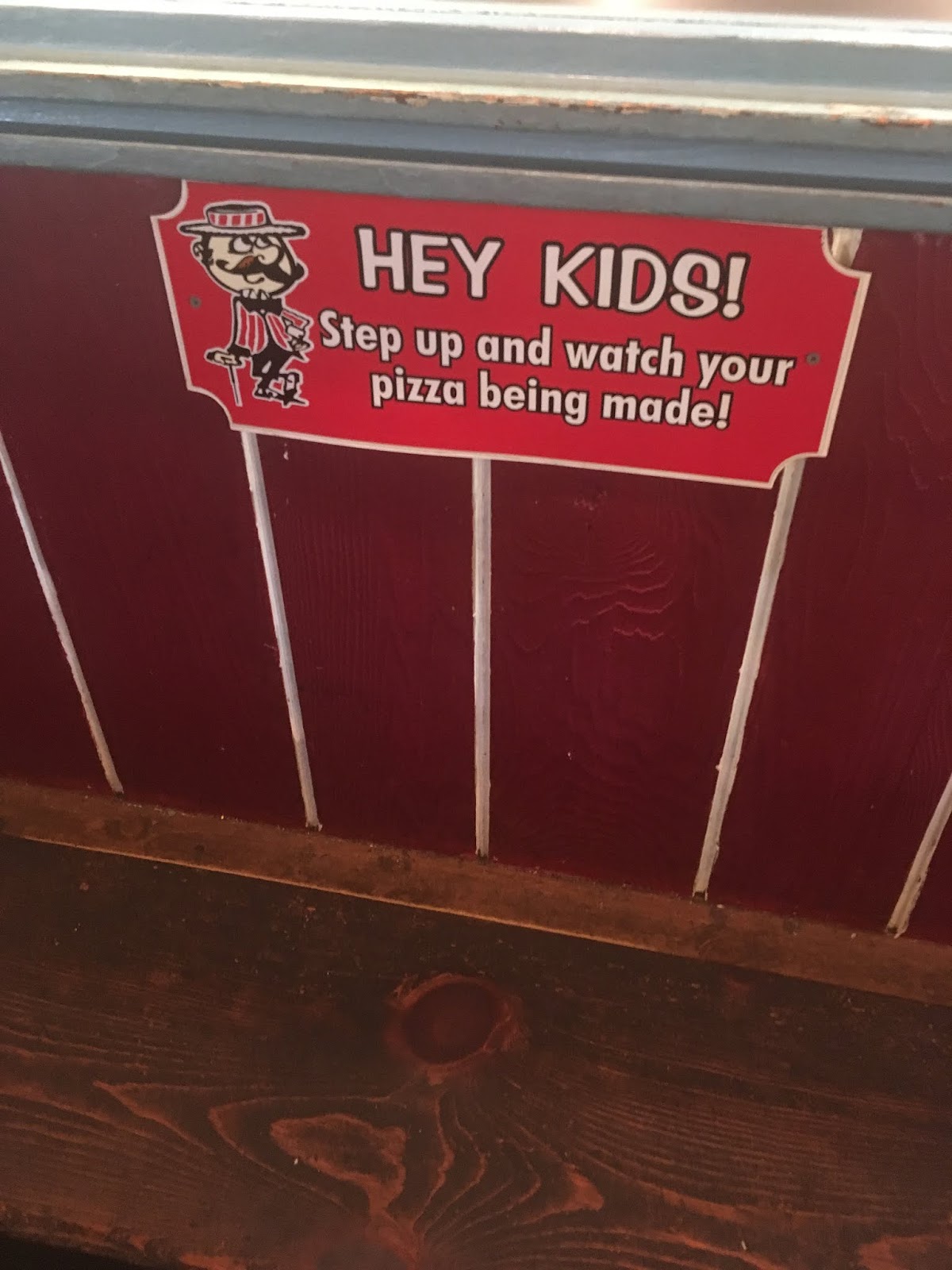
There were several other signs that started with, "Hey kids!"

I was a bit surprised when I got the bill, as my Stromboli, salad, and diet brown soda set me back nearly $20 before a tip for my server, but the economics of pizza tend to favor large groups sharing several large pies over a lone diner eating a single pizza pouch. On my next trip to Pappy’s having a few friends along to help me sample different pizzas and entrees would no doubt result in a better experience, though finding a handful of well-wishers willing to ride along with me to Western Pennsylvania for a meal might be too tall an order for most, if not all of my friend group. 

I need to figure out if I can still join Pappy's Birthday club. 

After paying my bill, I took a quick lap of the dining room to ensure I was fully appreciating the Pappy’s experience. I walked past the window into the kitchen that allowed me to look at employees shaping and topping circles of pizza dough, through the Rax-like solarium that housed an odd grand piano that I regret not taking a picture of, and finally into Pappy’s Fun Zone, a small arcade on the far side of the dining room. I had intended to play a game or two of pinball, but I couldn’t get the old woodgrain-covered change machine to accept my dollar bills. I did at least manage to appreciate the Tiffany-style Pappy’s lamp that hung from the ceiling. It was the only one in the place, but I suspect there were more at one time. It’s the kind of unique branded decor that collectors drool over and dream about hanging over their kitchen tables. (I’m talking about me. I’m “collectors!”)

I'm Pappy. Welcome to my fun zone!


This lamp is the kind of thing that would fetch a few hundred bucks on eBay. 

After the death of the elder Edith Bouvier Beale in 1977, her daughter would eventually sell the dilapidated Grey Gardens estate with the stipulation that the house not be demolished. The buyer, Washington Post editor Ben Bradlee, spent what was sure to be an obscene amount of money refurbishing the property to habitable condition, erasing what had been the backdrop to an iconic film in the process. Grey Gardens’ fate served to show that nothing lasts forever in a patinated state, even cultural icons. For all it’s foibles, The Johnstown Pappy’s Family Pub feels special in the way so many broken chain locations do. Each graffitied table, painted Pappy sign, and overflowing terlet, is a little piece of endangered history, and while Pappy’s is an operational restaurant in original condition today, its overall rough condition and the climate of the Pizza Economy at large may mean its days are numbered. I advise anyone nearby with even a passing interest in broken chains to visit Pappy’s while they still can. As Edith the Elder would say, Pappy’s stands on concentrated (sic) ground. 

The only official account of the history of Pappy's Family Pub that I could find. 

If you’re reading this and feel yourself drawn to surviving outlets of broken chains, consider joining me at the Harlan, Kentucky Rax this November in observance of Raxgiving. Those who attend will learn firsthand that I do terrific dances.


Wednesday, August 7, 2019

Damon's Wanes


I was raised with a strong sense of familial obligation. My parents attempted to instill in me a belief that I should spend time with my various relatives whether I liked it or not. This caused quite a bit of conflict over the first couple decades of my life, because most of the time, I preferred to be alone.

When my maternal grandparents retired in the early 1990s, they moved to Central Kentucky from Eastern Ohio for the expressed purpose of being near my brother and myself, their only grandchildren. As a result they expected my parents to drop everything, and show up at their house with me and my brother every Sunday for a large midday meal followed by endless hours of requisite socializing. It was not unlike the Friday night dinners that Rory and Lorelai had to endure on Gilmore Girls, except there was no alcohol and the menu was always the same pot roast and mashed potatoes.

Naturally, as I grew into my tween and teen years I began to dread this weekly ritual, as it took up a sizable chunk of the weekend in which I’d rather be playing video games or being alone with my thoughts. (I was a weird kid.) Regardless of my protests, however, I was always dragged along, week after week, by my parents who themselves were harassed and guilted into the same Sunday visit by my overbearing grandparents. This went on nearly every Sunday for a solid 12 years.

I thought I had escaped my ancestral obligation when I moved to Illinois for college, but by then, my grandparents had aged to the point that they were becoming incapable of doing the things that they had come to enjoy in their retirement. It was around that time that, out of a strong sense of familial obligation, my mother assumed the role of their assistant and wrangler for the various road trips they’d take regularly throughout the year, shepherding them to and from Florida in the winter and to the annual car show in Hershey, Pennsylvania in the fall.

Coincidentally, I was roped into assisting on a few of these trips when I was home for the summer, and rather than going anywhere fun, I always wound up being my grandparents' chauffeur and de facto butler on trips to Steubenville, Ohio. Situated in Ohio’s eastern edge where it meets the vertical skinny part of West Virginia, Steubenville and the surrounding communities had been where my grandparents spent their entire lives up until their retirement. It had been a steel town in its heyday with mills running day and night and polluting the air and nearby Ohio River, but as the steel industry declined, so did Steubenville, whose air and watershed became cleaner, but whose skyline was permanently scarred by the rusted and crumbling hulks of derelict mills.

It was against this backdrop of the decline of both my grandparents’ abilities and American industry that I first discovered Damon’s Grill. Whether I was dragged along to Steubenville for a family reunion or funeral, we’d always end up having a meal at the Damon’s attached to the Holdiay Inn on University Boulevard. While I was indifferent at best to the sports bar atmosphere, the food was good and the service was quick. A meal At Damon’s always provided a welcome respite from a weekend of driving my grandparents around in their Cadillac while arguing with them over directions and speed limits while gently reminding my increasing combative grandfather that he could not have two large McDonald’s milkshakes not only because it was a generally bad idea to consume half a gallon of milkshake, but also because he was diabetic.

Damon’s was founded in Columbus, Ohio in 1979 and, thanks to franchising, grew to a nearly 140 unit chain across the American Midwest and Southeast as well as the UK. In 2009, amid recession and increased competition, the company declared bankruptcy and all company owned, and most franchised, locations closed as a result. Today, there seem to be a total of five Damon’s locations still open. In the US, there's one in Hazleton, Pennsylvania, another in Myrtle Beach, South Carolina, and a third in Wilmington, Ohio. There are an additional two still operating in the UK in Lincoln and Sheffield. All five are formerly franchised locations that operate essentially independently.

More than ten years after my last Damon’s meal, I found myself on the way from my home in Michigan back to Central Kentucky for another family gathering. (Despite my tumultuous adolescence, I suppose that I too, have a strong sense of familial obligation as an adult.) Bored of my usual route down I-75, I opted to follow US 68 from its northwestern terminus in Findlay, Ohio to Lexington, Kentucky, a route which took me through Wilmington, home to Ohio’s last Damon’s, and my lunch stop that day.


It was midday on a weekday when I navigated past the seedy looking motel that shares a parking lot with the Wilmington Damon’s. It was around noon on a weekday, and the place seemed about half full of mostly elderly clientele, including one of those groups of old ladies who wear funny red hats. I was shown to a well-worn U-shaped booth facing a quartet of projection screens showing sports and news. A pair of dials on an odd apparatus that also held a speaker allowed me to switch between the audio of each broadcast and control the volume. It’s a shame that I’m bored by sports and depressed by news, because I thought the setup was pretty neat. 


I found myself wishing that they showed Gilmore Girls or Dukes of Hazzard reruns on any of the screens, as either of those shows would have enhanced my dining experience more than college baseball or the 24 hour news cycle. (Incidentally, outdoor shots for both shows were filmed on the same set, which is why downtown Hazzard County and downtown Stars Hollow look so much alike.)


I ordered a Diet Coke when my waitress arrived, and browsed the menu, whose back cover showed multiple 7.99 lunch specials. I don't remember even bothering to open the menu after seeing the bratwurst sliders, which is what I ended up ordering. I couldn't remember the last time I'd had a good bratwurst. While I waited for my food, I looked around at the interior of the place. While the outside of the building was visually striking with its gray siding with red and white accents and prominent cupola, the inside felt pretty standard with medium tone wood paneling adorned with prominent Ohio State memorabilia. I realize that many people from both Ohio and Michigan have strong opinions about Ohio State University athletics, but I am not among them. I was busy trying to get my mind's transmission to engage any gear other than neutral regarding Ohio State when my food showed up. 


The miniature bratwursts on my plate sat on similarly diminutive hot dog buns, and were served without garnishes or condiments. The menu showed grilled onions on top of them, and I was slightly let down by their absence. Regardless, the sausages were perfectly edible, and a nice change of pace from my normal burger and taco-based lunchtime proteins. The fries were the lightly battered variety, about which I have mixed feelings. (Battered fries seems like a combination of too many starches, and feel akin to cheating one's way to making fries crispy on the outside.) There was a creamy, stringy coleslaw as well. It was a perfectly decent lunch for 10 bucks with a tip. I have no idea if anything I ate was authentic to pre-bankruptcy Damon's, but it's almost not worth thinking about. 


Aside from the novel controls for the audio matching the larger than life video projections on the wall, not much about Damon's felt distinctive or exciting, which seems to be part of the reason for Damon's bankruptcy in the first place. Their food, atmosphere, and overall experience simply didn't stand out in a crowded field. However, we've established that a place like Damon's isn't really my scene anyway. I have similar feelings about both Bennigan's and Fricker's. They're places designed to cater to people who enjoy sports and socializing, two of my least favorite things, so I'm anything but objective when it comes to evaluating such a place. The fact that this Damon's and four others are still in business ten years after their corporate parent gave up on them tells a different story. The towns that still have a Damon's location obviously hold them in high enough regard that they've been able to keep their doors open despite all odds, and I'm glad they have. It's love and support from the local community, coupled, perhaps with a distinct lack of nearby competition that keeps the surviving locations of broken chains going. Even if I don't always have a memorably positive or negative experience, my own passion for documenting broken chains, coupled perhaps with a smattering of personality quirks, will keep me on the road seeking them out and telling you fine folks all about them here. 


Broken Chains Merch


Sunday, July 28, 2019

Hamburger Pavilion


No portion of the American fast food landscape is as crowded as the burger segment, and it seems that regardless of how novel or superior of a product a chain offers, its cachet will always fall short of the iconic status enjoyed by chains represented by a clown, a king, and a girl with pitgtails. Meanwhile, Yum! Brands, the company spun off from PepsiCo's restaurant division in 1997, controls the remainder of fast food chains that enjoy icon status but don't serve burgers. Try as they might though, the owners of the KFC, Taco Bell, and Pizza Hut brands have never managed to make it into the burger game, and their attempts have left brands like Hot 'n Now and the American iteration of A&W reeling as Yum! proceeded to rapidly acquire, expand, and mismanage them before casting them aside to focus on their more successful and profitable brands. Seemingly, every burger brand Pepsico/Yum! touches seems to fall apart, and the same can be said for Back Yard Burgers, even though they had only the briefest of flings with Yum!

Like Hot 'n Now and Central Park, Back Yard Burgers was a product of the second wave, low overhead, drive thru only, burger fad of the 1980's. The first location was opened by the seemingly backward-named Lattimore Michael in Cleveland, Mississippi in 1987. The chain spread across the south, adding inside dining rooms along the way, and in the early 2000s, briefly had a deal with Yum! to operate co-branded locations with KFC, Taco Bell, and Pizza Hut. While the chain peaked at around 150 locations a decade ago, they quickly fell prey to the Yum! burger curse. A series of ownership changes and a boardroom brawl that precipitated a CEO's dismissal took Back Yard Burgers past the Cici's Point to Broken Chain status. Today, there are 45 Back Yard Burgers locations still in operation spread across nine states. Two thirds of those locations are in Missisippi and Tennessee, showing Back Yard Burgers has receded to its home market leaving only a few isolated stragglers behind as far away as North Carolina and Illinois.

Until a few weeks ago, I had never eaten at a Back Yard Burgers, though I had a vaguely positive opinion of them. My middle school years in Central Kentucky's Bluegrass region were marked by a debate that, from my perspective, was waged exclusively using passive-aggressive bumper stickers. It was during those years of the late 1990s that Lexington was expanding outward, most notably on its far east side where the grounds of the historic Hamburg Place Stud Farm had been sold to developers who were rapidly turning the area into Hamburg Pavilion, a sprawling shopping center that would permanently alter Lexington's retail landscape. Proponents of the new development and the economic prosperity it would bring plastered the posteriors of their vehicles with bumper stickers proclaiming "Growth is good!" While the vehicles of the opposition, enraged by the loss of a historic thoroughbred horse farm wore decals that countered with, "Growth destroys the Bluegrass forever." I didn't have much of an opinion on the matter at the time, but I did love the newly built Hamburg Pavilion when it opened. The new shopping center brought new and exciting brands with it. Hamburg Pavilion was the first place I ever saw a Meijer store and a Steak 'n Shake. The Regal Cinema at Hamburg was the first theater with stadium seating I ever visited. All of these places were immensely exciting for me to visit as an adolescent raised on McDonald's and Walmart. Hamburg was also home to Lexington's first Back Yard Burgers location, and while I never managed to eat there before it closed, my high regard for the brand was by virtue of that location's proximity to the shiny new businesses I found so exciting in my younger years.

The menu board and bizarre tile-less drop ceiling gave the place an early 2000s vibe.

Recently, I happened to be in Lexington visiting family and found myself with an afternoon free of familial obligations. I found myself traveling down US 27 toward Somerset, Kentucky home to one of Kentucky's three surviving Backyard Burgers locations to see if the brand could live up to the positive associations I had developed 80 miles north at Hamburg Pavilion. I'd had an early start that morning, and had been enjoying some other retail sites in town. As a result, I was ready for lunch when I walked into Back Yard Burgers a few minutes past their 10:30 AM open time. My initial impressions of the place were positive. Despite the brand's decline, the owners of the Somerset location seemed to have kept up the building well. The dining room felt clean, if not modern, and the parking lot had been repaved recently. After briefly surveying the menu board, I ordered up a 1/3 Bacon Cheddar Burger combo, and upgraded my side to garlic Parmesan waffle fries thanks to a helpful sign on the counter that advertised that option. As soon as I had selected a booth near the window that looked out on the bright yellow outside tables where a lone employee was raising each table's umbrella, my order was ready.

Generic-feeling supplemental signs on the counter advertised limited time menu offerings. 

With its premium bun and single leaf of wilted romaine, the burger bore a stronger resemblance to something I'd encounter in a sit-down restaurant than in a fast food setting. The flavor lived up to the chain's name, as it tasted as if it had been cooked on a grill in a suburban back yard, and judging from the open propane grill in the kitchen, the flavor was genuine, but the more of it I ate, the more it reminded me of a Hardee's burger, which itself is still an above average product, but the lack of distinctiveness of the Back Yard Burger made for a slight let down. Regardless, it was still far superior to any allegedly flame-broiled item I've ever had at Burger King, whose hamburger patties I suspect are constructed of pressed animal trimmings, artificial beef flavor, and chemical flame broiling agents. The Parmesan garlic fries were decidedly heavy on Parmesan and light on garlic. The hearty waffle fries had been sprinkled liberally with Parmesan powder that I most often associate with shaking out of a green can onto a plate of spaghetti. The mounds of dry cheese powder on the fries overwhelmed any garlic flavor that may or may not have been added, and made the fries difficult to eat without aspirating cheese dust in the process.

A fun-looking outside dining area.

I had noted another helpful sign on the order counter advertising blackberry and apple cobblers, and I couldn't resist the temptation of sampling such a unique and novel fast food dessert item. The employee with whom I placed my dessert order seemed genuinely surprised that I wanted to conduct a second transaction after ordering a burger and fries, but obliged my request for an order of the blackberry cobbler and a scoop of ice cream. She served the former out of a large warming tray of cobbler, placing a scoop of the runny pie into a small Styrofoam bowl. She then produced an identical bowl containing a single scoop of vanilla ice cream from a small freezer behind the counter before placing both items on a small tray and handing them to me. This presented a problem back at my table. Each bowl was too small to contain both ice cream and cobbler, and my attempt to transfer one to the other resulted in the cobbler bowl overflowing. I suppose the tray's main purpose in this instance was to contain cobbler runoff. It became more manageable to eat after the first few bites made room for more ice cream and made overflows less of an issue, but my desire to finish the dessert was not strong.

Above average burger and unique, if disappointing fries


I don't make a habit of eating blackberry cobbler. I don't remember the last time I had tasted it before this adventure, so I don't have much of a frame of reference for what good blackberry cobbler should taste like. I found the Backyard Burgers iteration to be insufficiently sweet and possessing an unpleasant medicinal flavor. If Blackberry flavored NyQuil were a thing, I'm pretty sure it would taste like Back Yard Burgers blackberry cobbler, but I suspect this flavor is inherent to some extent in all blackberry cobbler and blackberry products in general. In short, I think the problem is not that Back Yard Burgers makes bad blackberry cobbler, but that I simply don't like blackberry cobbler.

Too much cobbler, not enough bowls

After a few years in the spotlight, expanding rapidly, Back Yard Burgers is soldering on as a broken chain both in the Mississippi River Delta and in a handful of far-flung outposts. Thanks to an above average burger and a well-maintained building in Somerset, Kentucky, my perception of the brand remains as it was when a Back Yard Burger was only an intangible idea projected into my brain at Hamburg Pavilion. I feel the same generally positive vibe but without excessive fervor or excitement for Back Yard Burgers having eaten there that I did when it was just a building that I'd pass on the way to Meijer. I'd gladly eat there again, but it doesn't elicit the same excitement I feel for other broken chains I've encountered and experienced for the first time.

Mr. Zap Actionsdower in a dessert mess, yeah yeah yeah yeah. 

That slight let-down compelled me to drive another 110 miles to Harlan, Kentucky, straight from Somerset, for a meal at my favorite Rax, which never disappoints. Speaking of, if you happen to be anywhere near the Harlan, Kentucky Rax on Friday November 29, 2019, you can join me in observance of the broken chain holiday of Raxgiving. There will be copious sandwiches, twisty fries, baked potatoes, and the signature Rax Endless Salad Bar. I'm working on some Raxgiving-exclusive giveaways too. You can find more details about the event here.